Showing posts with label Women's Fashion. Show all posts

Churidar Hosiery (1)

9/20/2014 Add Comment

01-Churidar


Churidars  or more properly churidar pyjamas are tightly fitting trousers worn by both men and women in South Asia. Churidars are a variant of the common salwar pants. Salwars are cut wide at the top and narrow at the ankle. Churidars narrow more quickly, so that contours of the leg are revealed. They are usually cut on the bias, making them naturally stretchy. Stretch is important when pants are closefitting. They are also longer than the leg and sometimes finish with a tightly fitting buttoned cuff at the ankle. The excess length falls into folds and appears like a set of bangles resting on the ankle (hence 'churidar'; 'churi': bangle, 'dar': like). 


When the wearer is sitting, the extra material is the "ease" that makes it possible to bend the legs and sit comfortably. The word churidar is from Hindi and made its way into English only in the 20th century.  Earlier, tight fitting churidar-like pants worn in India were referred to by the British as Moghul breeches, long-drawers, or mosquito drawers.

The churidar is usually worn with a kameez (tunic) by women or a kurta (a loose overshirt) by men, or they can form part of a bodice and skirt ensemble.

Sleeved blanket Gown(23)

9/12/2014 1 Comment

 Sleeved blanket


A sleeved blanket is a unisex body-length blanket with sleeves usually made of fleece or Vellux material. It is similar in design to a bathrobe that is meant to be worn backwards (i.e., with the opening in the back). The product has been marketed by various brands as the Snuggie, Snuggler, Doojo, Toasty Wrap, and Slanket, with varying sizes, colors and qualities of materials but similar basic design.The "Snuggie" brand itself also became a phenomenon of pop culture, outselling other brands and being referenced or imitated by many comedians or TV shows.

Popularity

In late 2008 and early 2009 the Snuggie brand of sleeved blankets became a pop culture phenomenon, sometimes described humorously as a "cult" 

The product became famous after a direct response commercial promoting the product was aired. It was featured on television programs like Today where cast and crew donned Snuggie blankets for a segment which was described as looking like a gospel choir. Others have described mass-snuggie wearing as looking like a Harry Potter convention.The Associated Press likened it to a "monk's ensemble in fleece" and proclaimed it the "ultimate kitsch gift". The Snuggie initially sold singly for $14.95, and later in sets of two for $19.95.

Commercial variations

The Slanket was created by Gary Clegg using a sleeping bag in Maine in 1998 (before the Snuggie). Clegg's mother made him a blanket with a single sleeve for use in his cold dorm room. Clegg later developed that into the Slanket with two sleeves.

The Snuggie sleeved blanket product has been sold in the United States, Canada, and Australia. It was marketed primarily through a memorable television commercial. As of January 2009, over 20 million of the product had been sold.

Travel blanket for children (up to size 5) which complies with federal safety regulations for car seats and strollers. GO-GO Blankets were created in 2007 by a grandmother in New Jersey who wanted to find a solution to keeping children safe and warm in a car seat without bulky winter wear.


There is also an Italian version sold in Europe, Canada, and Japan called the "Kanguru" with a pocket in the middle

Sack-back Gown(22)

9/11/2014 Add Comment

Sack-back gown


The sack-back gown was a women's fashion of the 18th century. 

At the beginning of the century, the sack-back gown was a very informal style of dress. At its most informal, it was unfitted both front and back and called a sacque, contouche, or robe battante. By the 1770s the sack-back gown was second only to court dress in its formality. This style of gown had fabric at the back arranged in box pleats which fell loose from the shoulder to the floor with a slight train. In front, the gown was open, showing off a decorative stomacher and petticoat. It would have been worn with a wide square hoop or panniers under the petticoat. Scalloped ruffles often trimmed elbow-length sleeves, which were worn with separate frills called engageantes.

The loose box pleats which are a feature of this style are sometimes called Watteau pleats from their appearance in the paintings of Antoine Watteau. The various Watteau terms, such as Watteau pleat, Watteau back, Watteau gown etc., date from the mid-19th century rather than reflecting authentic 18th century terminology, and normally describe 19th and 20th century revivals of the sack-back.


Notable wearers

A popular story, traced back to the correspondence of Élisabeth Charlotte d'Orléans, Duchess d'Orléans, is that the earliest form of the sack-back gown, the robe battante, was invented as maternity clothing in the 1670s by Louis XIV's mistress to conceal her clandestine pregnancies. However people would comment: "Madame de Montespan has put on her robe battante, therefore she must be pregnant.


Brief 

The sack, or sacque, gown evolved from a very informal dress of the late seventeenth century into a formal dress by the mid-eighteenth century. The sack gown was first a loose, tent-like robe worn in the home or by pregnant women. The volume of the gown came from gathers near the shoulders and along the back. The front of the gown skirt was worn either open in the front to reveal a petticoat or stitched closed from the waist down to the hemline. As the century continued, these gowns became more formal, featuring fitted bodices, long full skirts, and a long box-pleated piece of fabric hanging from neck to ankles along their backs. These dresses were so often depicted in the paintings of French painter Antoine Watteau (1684–1721), the man who created the Rococo painting style that emphasized romantic love, that the pleats in back took his name: Watteau pleats. As the dresses became more fitted through the bodice, the gown came to be known as the robe à l'anglaise. The robe à l'anglaise was especially popular in England (anglaise means English in French) and featured a many-pieced bodice with a low neckline. The sack gown went out of style by the end of the century when Greek inspired dresses, such as the robe en chemise, became popular.

Rochet Gown(21)

9/10/2014 Add Comment

Rochet


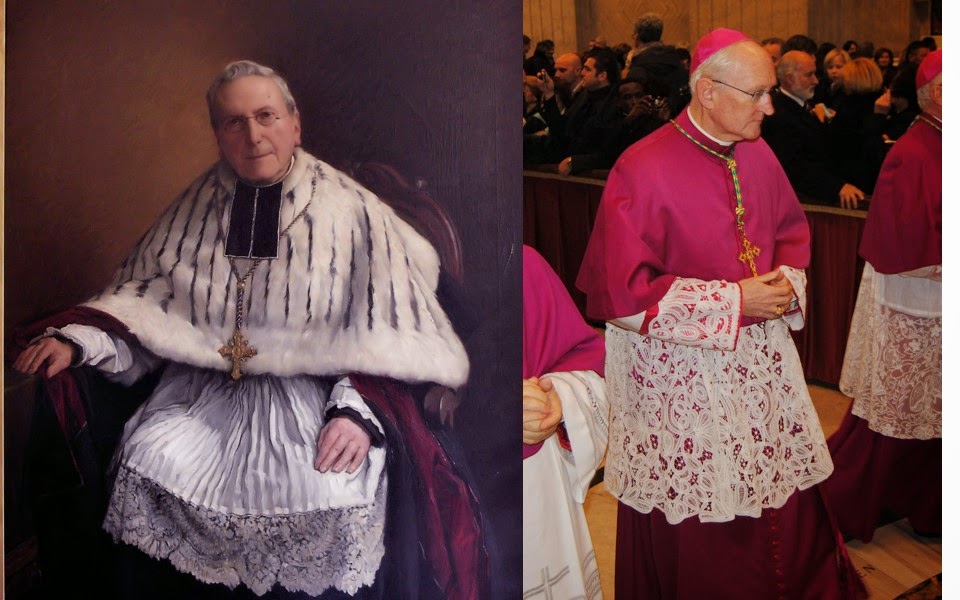
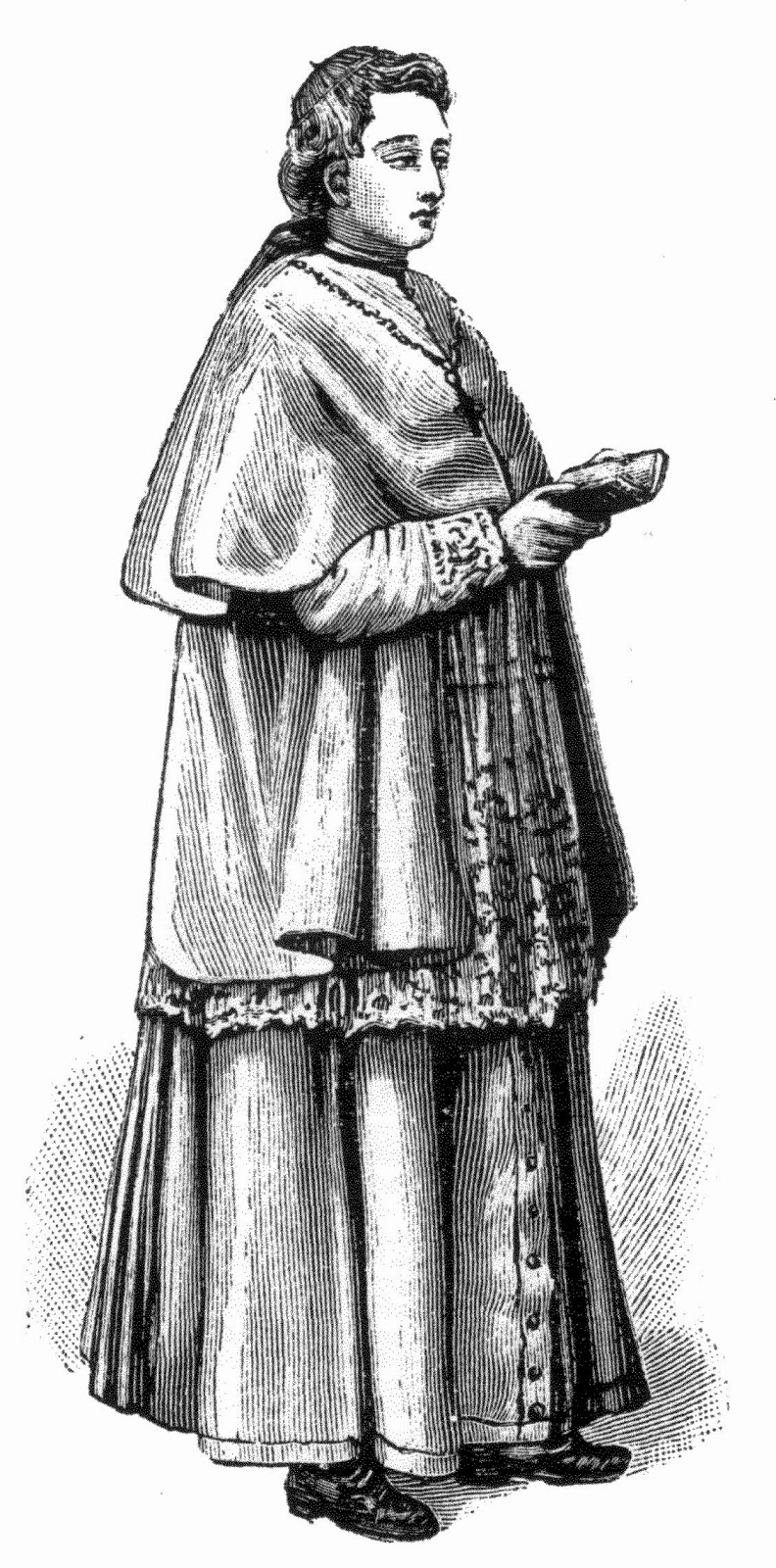
A rochet is a white vestment generally worn by a Roman Catholic or Anglican bishop in choir dress. It is unknown in the Eastern churches. The rochet is similar to a surplice, except that the sleeves are narrower. In the Roman Catholic tradition, the rochet comes below the knee and its sleeves and hem are sometimes made of lace; in the Anglican tradition, the rochet comes down almost to the hem of the cassock and its sleeves are gathered at the wrist.

The word stems from the Latin rochettum (from the late Latin roccus, connected with the Old High German roch, roc and the A.S. rocc; Dutch koorhemd, rochet, French rochet, German Rochett, Chorkleid, Italian rocchetto, Spanish roquete), means an ecclesiastical vestment.

Catholic use

The Catholic rochet is a tunic of white, usually fine linen or muslin (batiste, mull) reaching about to the knee, and distinguished from the surplice mainly by the narrower sleeves which make its arms tight-fitting, and is frequently trimmed with lace. The lower edge and the sleeves may also be garnished with lace, lined with violet or red silk in the case of prelates, or more rarely with embroidered borders.

The rochet is proper to, and distinctive of, prelates and bishops, but the right to wear it is sometimes granted by the pope to others, especially the canons of cathedral churches. It is not a vestis sacra, and cannot therefore be used as a substitute for the surplice, e.g. in the administering of the Sacraments (Decree of the Congregation of Rites of January 10, 1852). Nonetheless, since it is used at choir services and is ordered to be worn over the everyday dress at Mass (Missa rom. Rit. celebr. i. 2), it may be included among liturgical vestments in the widest sense. It is worn instead of a surplice by Canons Regular as part of their habit for liturgical use alone.

The rochet was originally a robe-like tunic, and was therefore girdled, like the liturgical alb. So as late as 1260 the provincial synod of Cologne decreed that the vestis camisialis must be long enough entirely to cover the everyday dress. A good example of the camisia of the 12th century is the rochet of Thomas Becket, preserved at Dammartin in the Pas de Calais, the only surviving medieval example remarkable for the pleating which, as was the case with albs also, gave greater breadth and more elaborate folds. In the 15th century the rochet only reached halfway down the shin; in the 16th and 17th to the knee; in the 18th and 19th often only to the middle of the thigh.

In the Middle Ages it was always plain.


Anglican use

In the Anglican Churches the rochet is a vestment peculiar to bishops and is worn by them in choir dress with the chimere, both in ministration in church and also on ceremonial occasions outside, e.g. sitting in the House of Lords, attending a royal levee, or commencement ceremony. It may be worn with a stole, cope and mitre for more dignified occasions (such as Baptism outside the context of the Eucharist, Solemn Evensong, royal weddings and the coronation of the Sovereign).

In general it has retained the medieval form more closely than the Roman rochet and more resembles the alb, insofar as it is of plain, very fine linen, and reaches almost to the feet. The main modifications have been in the (usually) baggy 'lawn' sleeves that are gathered at the wrists with a band of black or scarlet cloth. At the time of the Reformation these were still narrow, though already showing a tendency to expand. The portrait of Archbishop Warham at Lambeth, for instance, shows a rochet with fairly wide sleeves narrowing towards the wrists, where they are confined by fur cuffs. This fashion continued until, in the 17th century, the sleeves became much fuller; only in the 18th century did they develop into the familiar exaggerated balloon shape, confined at the wrists by a ribbon, beyond which a ruffle projected. About the same period, too, arose the custom of making the rochet sleeveless and attaching the lawn sleeves to the chimere. This remained the fashion most of the 19th century, but there has since been a tendency to revert to the earlier less exaggerated form, and the sleeves have been reattached to the rochet. The ribbon by which the wrist is confined is red, except when conducting or participating in a formal, public funeral (e.g. of a head of state), when it is black.

The rochet is worn without the chimere under the cope by those bishops who use this vestment. At his consecration the bishop-elect is, according to the rubric, presented to the consecrating bishops vested in a rochet only; after the laying on of hands he retires and puts on the rest of the episcopal habit; i.e. the chimere.

One exception to the normal Anglican-style is the rochet worn by the previous Archbishop of Canterbury, Rowan Williams which has open-ended narrow sleeves in the manner of the Roman rochet.


Nightshirt Gown(19)

9/10/2014 Add Comment

Nightshirt


A nightshirt is a garment intended for wear while sleeping. It is somewhat longer than most regular shirts, reaching down to the thighs or below the knees,leaving some of the legs uncovered. It is generally loose-fitting to avoid restricting the wearer's movement while sleeping.


Until the 16th century men slept naked or in a day-shirt; subsequently a night-shirt, varying in quality, was worn in bed. Nobles in the 16th century wore embroidered shirts or "wrought night-shirts". By the 19th century the night-shirt resembled a day-shirt with a loose, turned-down collar, or a loose, ankle-length nightgown was worn. A most notable cartoon character who wears a nightshirt is Squidward Q. Tentacles. To this day, they are still know as being a comfortable form of nightwear. 

Occasionally worn in the 20th and 21st centuries by women as well.

Nightgown (18)

9/10/2014 Add Comment

Nightgown


A nightgown, nightie or nightdress is a loosely hanging item of nightwear, today almost exclusively worn by women. A nightgown is made from cotton, silk, satin, or nylon and may be decorated with lace appliqués or embroidery at the bust and hem.

A nightgown may have any neckline, and may have sleeves of any type, or be sleeveless, and any shoulder strap or back style. The length of a nightgown may vary from hip-length to floor-length. A short nightgown can be called a "shortie" or a "babydoll", depending on the style. A slip nightgown may be used as a nightgown or as a full slip. Nightgowns may be worn with a matching outer garment, a robe, sheer chiffon peignoir or dressing gown, to make them appropriate for receiving guests

major classess are

  • Negligee
  • Olga Night Gown
  • Sleep Shirt
  • Slip Gown
  • Baby Doll Gown etc.