Showing posts with label Traditional. Show all posts

Jinbei - Jacket

6/19/2016 Add Comment

A jinbei, alternately jinbe or hippari, is a kind of traditional Japanese clothing worn by men, women, boys, girls, and even babies during the summer. Women's jinbei have started to become popular in recent years.021-Jinbei_Set

Use

Jinbei are usually worn as a form of nightwear or house wear. Normally, male Japanese would wear jinbei only within their own homes, or outside the home when in close proximity to it (for example, to collect the mail or go on a local errand, or sometimes even while shopping or dining at a local restaurant). Sometimes jinbei are used as substitute for yukata during a summer festival, typically by men and boys but also frequently by young women. Ladies' jinbei tend to be more brightly coloured and often feature prints of popular culture characters and motifs.

Set

Jinbei sets consist of a top and matching shorts, although some have long pants and some come with both short and long pants. Traditional jinbei are made from hemp or cotton and are dyed a uniform color, often indigo, blue, or green (though modern jinbei frequently have prints ranging 022-Jinbei_Set -side seamsfrom simple textures or lines to complicated and colorful floral patterns). The top resembles a short-sleeved or sleeveless jacket that falls to the hips. It ties closed both inside and outside the jacket, with the inside tied first, the jacket folded over to the person's left, and then tying the outside.

The seam for jinbei is very loosely woven to allow for ventilation during hot weather while retaining coverage.

Surplice Gown(25)

9/12/2014 Add Comment

Surplice


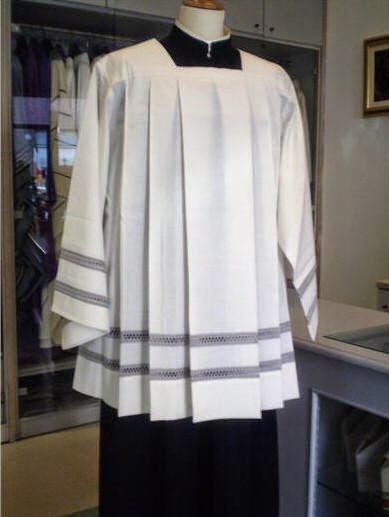
A surplice (Late Latin superpelliceum, from super, "over" and pellis, "fur") is a liturgical vestment of the Western Christian Church. The surplice is in the form of a tunic of white linen or cotton fabric, reaching to the knees or to the ankles, with wide or moderately wide sleeves.

It was originally a long garment with open sleeves reaching nearly to the ground, as it remains in the Anglican tradition, but in the Catholic tradition, the surplice often has shorter, closed sleeves and square shoulders. Anglicans typically refer to a Roman-style surplice with the Medieval Latin term cotta [meaning 'cut-off' in Italian], as it is derived from the cut-off alb. English-speaking Catholics, however, typically do not make the distinction between the two styles, and refer to both by the term "surplice".


Origin and variation

It seems most probable that the surplice first appeared in France or England, whence its use gradually spread to Italy. It is possible that there is a connection between the surplice and the Gallican or Celtic alb, an ungirdled liturgical tunic of the old Gallican Rite, which was superseded during the Carolingian era by the Roman Rite. The founding of the Augustinian Canons in the second half of the eleventh century may have had a special influence upon the spread of the surplice. Among the Augustinian Canons the surplice was not only the choir vestment, but also a part of the habit of the order.

The surplice originally reached to the feet, but as early as the 13th century it began to shorten, though as late as the 15th century it still fell to the middle of the shin, and only in the 17th and 18th centuries in Continental Europe did it become considerably shorter. In several localities it underwent more drastic modifications in the course of time, which led to the appearance of various subsidiary forms alongside the original type. For example:

the sleeveless surplice, which featured holes at the sides to put the arms through
the surplice with slit arms or lappets (so-called "wings") instead of sleeves, often worn by organists today, due to the ease of maneuvering the arms
the surplice with not only the sleeves but the body of the garment itself slit up the sides, precisely like the modern dalmatic
a sort of surplice in the form of a bell-shaped mantle, with a hole for the head, which necessitated the arms sticking out under the hem.


The first two of these forms developed very early; and, in spite of their prohibition by synods here and there (for example that of Liège circa 1287), they survive in various places to the present day. The latter two only appeared after the close of the Middle Ages: the first of them in South Germany, the second more especially in Venetia, where numerous pictorial records attest its use. As a rule, however, only the lower clergy wore these subsidiary forms of surplice. They came about partly under the influence of secular fashions, but more particularly for convenience.


Houppelande Gown(13)

9/09/2014 Add Comment

Houppelande

A houppelande or houpelande is an outer garment, with a long, full body and flaring sleeves, that was worn by both men and women in Europe in the late Middle Ages. Sometimes the houppelande was lined with fur. The garment was later worn by professional classes, and has remained in Western civilization as the familiar academic and legal robes of today.


The houppelande appeared around 1380 and was to remain fashionable well into the next century. It had its origins in the herigaut, a similar thirteenth-century garment with hanging sleeves.The edges of the houppelande were often dagged, or cut into decorative patterns such as scallops, "embattled" tabs or even leaf shapes.

The houppelande is a specific kind of medieval overdress which was widely worn in the 15th century. It replaced the more fitted surcotes and overgowns, although like them, often showed off the gown underneath which was more costly and expensive. Technically, is is a surcote, but became known as a garment in its own right. It was always worn with an undergown, never alone.

Distinguishing features.

The distinguishing featrues of the houppelande, were a high collar or neck opening, big sleeves and a voluminous amount of fabric in the lower part of the gown. There were many different sleeve types, but most used a large amount of fabric compared to previous gowns and fitted kirtles. It was always belted under the bust at the back with a fabric belt which might have expensive decorative metal buckles and ends. When the fabric is gathered under the bust, it forms pleats in the fabric. The houppelande was not constructed with a seperate bodice like some other styles of gown


Houppelandes almost always seem to be depicted with a fur lining and were usually worn with the heart shaped head-dress or the horned head-dress and veils.


further reading
http://www.virtue.to/articles/circle_houp.html

Hospital Gown(12)

9/02/2014 Add Comment

 Hospital Gown

A hospital gown, also called a "Johnny Gown" is "a long loose piece of clothing worn in a hospital by someone doing or having an operation.It can be used as clothing for bedridden patients.

Utility

Hospital gowns worn by patients are designed so that hospital staff can easily access the part of the patient's body being treated. The hospital gown is made of fabric that can withstand repeated  laundering in hot water, usually cotton, and is fastened at the back with twill tape ties. Disposable hospital gowns may be made of paper or thin plastic, with paper or plastic ties.


Some gowns have snaps along the top of the shoulder and sleeves, so that the gown can be removed without disrupting intravenous lines in the patient's arms. Used paper hospital gowns are associated with hospital infections, which could be avoided by proper disposal.


Design

Many patients feel that hospital gowns are unfashionable, and in  2010 Diane von Furstenberg was commissioned to design stylish hospital gowns based on her fashionable wrap dress by a Cleveland clinic.

Joel Sherman in his blog "Adolescent Boys and Genital Exams Reducing Embarrassment" says it is quite common for many teenage boys to be upset when changing into a hospital gown, especially if the wearer associates the look of the gown to women's clothing, women's nightgowns, or lingerie.


According to the BBC, in England hospital gowns are made much more modestly, taking patient dignity into consideration

Cleanroom Gown(7)

8/30/2014 Add Comment

Cleanroom suit

A cleanroom suit, clean room suit, or bunny suit,is an overall garment worn in a cleanroom, an environment with a controlled level of contamination. One common type is an all-in-one coverall worn by semiconductor and nanotechnology line production workers, technicians, and process / equipment engineers, as well as people in similar roles creating sterile products for the medical device industry.

The suit covers the wearer to prevent skin and hair being shed into a clean room environment. The suit may be in one piece or consist of several separate garments worn tightly together. The suit incorporates both boots and hood. It must also incorporate a properly fitted bouffant cap or mob cap.

More advanced designs with face covers were introduced in the 1990s (like the Intel fab worker-style suits seen on the Pentium product advertisements).

Suits are usually deposited in a store after being contaminated for dry cleaning, autoclaving and/or repair.

Similar suits are worn in the containment areas of nuclear power plants. These suits consist of the main garment, hood, thin cotton gloves, rubber gloves, plastic bags over normal work shoes, and rubber booties. The wrists and ankles are taped down with masking tape. Occasionally a plastic raincoat is also worn. Removal of the garments (into several barrels) is a complicated process which must be performed in an exact sequence. Often a health physicist is present in the work area to observe good anti-contamination practices.

Pictorial Demonstration


Choir Dress Gown(5)

8/26/2014 Add Comment

Choir Dress

Choir dress is the traditional vesture of the clerics, seminarians and religious of Christian churches worn for public prayer and the administration of the sacraments except when celebrating or co-

celebrating the Eucharist. It differs from the vestments worn by the celebrants of the Eucharist, being normally made of fabrics such as wool, cotton or silk, as opposed to the fine brocades used in vestments. It may also be worn by lay assistants such as acolytes and choirs. It was abandoned by most of the Churches which originated in the sixteenth-century Reformation.

Like eucharistic vestments it derived originally from the formal secular dress of the Roman Empire in the first centuries of the Christian era which survived in church usage after fashion had changed.

Choir dress also differs from "house dress" which is worn outside of a liturgical context (whether in the house or on the street). House dress may be either formal or informal.

Roman Catholic choir dress

Choir dress in the Catholic Church is worn by deacons, priests and bishops when presiding at or celebrating a liturgy that is not the Mass, especially the Liturgy of the Hours, or when attending Mass without celebrating or concelebrating the Eucharist. It is worn by seminarians, instituted lectors and acolytes, and altar servers and choir members at Mass or other liturgical events.

The basic components of choir dress are:

the cassock, with or without fascia (fringed sash worn around the waist),if the person is a brother or priest in a religious order that has its own habit (Benedictines, Franciscans, Dominicans, etc.), the habit is worn in place of the cassock,the surplice (or rochet if the wearer is a bishop, cardinal, or canon), andthe biretta (optional for secular priests unless their bishop requires 

its use, otherwise mandatory).For seminarians, deacons, and priests the cassock is exactly the same as their normal cassock: a black cassock with black buttons, girded with a black fascia.

Priests who hold additional honors may wear a different cassock: Chaplains of His Holiness wear a black cassock with purple piping, buttons, and fascia, while Honorary Prelates and Protonotaries apostolic wear a purple cassock with scarlet piping and buttons with a purple fascia. A black cassock with amaranth piping and buttons, girded with a purple fascia, serves as pian dress (academic dress) for an honorary prelate or protonotary apostolic. Canons may wear the rochet (if the chapter has been granted usus rochetti by papal indult) with a distinctive mozzetta, the particular colors of which are determined by the chapter.


Bishops wear the above-mentioned purple cassock with scarlet piping, and add a pectoral cross suspended from a green and gold cord, a mozzetta over the rochet, and a purple zucchetto under the biretta. A cardinal wears a scarlet cassock with scarlet trim, pectoral cross on a red and gold cord and a red mozzetta over the rochet, with a red zucchetto. The Pope's choir dress includes a white cassock, rochet, red silk mozetta, red brocade stole and his pectoral cross hangs from a golden cord. Some canons wear their cross on a ribbon, but only a bishop may wear the cross on a cord. Under new regulations, neither bishops nor canons wear fur trimmed cappas.

The cope and/or stole may be worn over choir dress when a cleric presides over a sacrament (for instance, at matrimony, if not celebrated during Mass), or by the cleric presiding over prayers (for instance, the priest presiding at a solemn celebration of Vespers in the Liturgy of the Hours at a seminary might wear cope and stole over choir dress, while the priests of the faculty and seminarians would wear simple choir dress of cassock and surplice).

Monks who are neither deacons nor priests also have a form of choir dress: the full monastic habit with the monastic cowl forms their formal wear for attending the Liturgy of the Hours or Mass.


Eastern choir dress

The choir dress of clergy in the Eastern Orthodox, Oriental Orthodox and Eastern Catholic churches are relatively similar. Over the inner cassock (rasson or podrasnik), a deep-sleeved exorason (riassa), which is often black, is worn. In the Russian Orthodox Church, married clergy often wear grey, while monastic clergy wear black. During the paschal season both monastic and married clergy will often wear a white inner cassock. Some Russian Metropolitans wear a white inner cassock and a blue outer when formally arriving to celebrate the Divine Liturgy.


Eastern Orthodox

In Eastern Orthodoxy and Byzantine Catholicism, monks wear a black cloak, the mandyas over the outer cassock. The mandyas completely covers the monastic below the chin and reaches to the floor. In the Greek usage, the mandyas is usually only worn when performing certain liturgical roles; in the Slavic usage, all monks and nuns of the rank of Stavrophore or above wear the mandyas at every service, so long as they are in their own monastery. The mandyas of an hegumen (abbot) is of black silk, that of an archimandrite or bishop is of colored silk (specific usages will differ by jurisdiction), and has four square "tablets" on it: two at the neck and two at the feet. A bishop's mandyas additionally has "rivers" on it: three horizontal stripes either of gold (Greek practice) or red and white (Slavic practice).

Monastic clergy wear different headcoverings than married clergy. Married clergy wear either a colored kalimaukion or skufia; monastic clergy wear a black kalimaukion and veil (together known as the klobuk). For monastics, the skufia is reserved for house dress, and the klobuk is worn in church. Russian archbishops have a jewelled cross attached to the front of their klobuks; Russian Metropolitans wear a white klobuk with jewelled cross. Several Orthodox Patriarchs wear a rounded headcovering called a koukoulion.

Priests who have been awarded a pectoral cross wear it with their choir dress (these pectoral crosses are of several degrees: silver, gold, or jewelled). Bishops wear a panagia (icon of the Theotokos) in place of the pectoral cross. Archbishops may wear a pectoral cross and a panagia. All primates and some bishops below primatial rank have the dignity of wearing an enkolpion (icon of Christ), a pectoral cross, and a panagia.

A ruling Igumen (so long as he is inside his own monastery) and a bishop may carry his paterissa (crozier) when he is in church. However, the paterissa is never to be carried inside the sanctuary; instead, when he goes into the altar, the paterissa is either handed to an altar server or left leaning against the iconostasis outside the Holy Doors.


In North America and Great Britain, some Orthodox clergy have begun to wear a Roman collar (clergy shirt), though this is discouraged among the more traditional Orthodox.

Anglican choir dress or choir habit

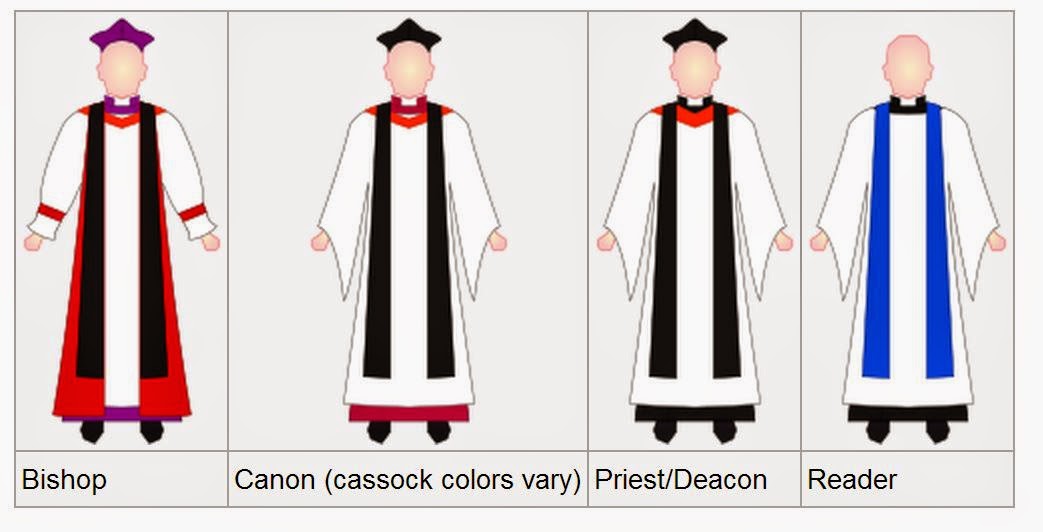
Choir dress in Anglicanism traditionally consists of cassock, surplice and scarf (or tippet).An academic hood may also be worn and, since 1964 in the Church of England a cope may be worn at the discretion of the minister.However, the basic garment was, and is, the surplice which by the fourteenth century had become the essential choir-vestment everywhere.The surplice was the only vesture permitted to the clergy in the 1552 Prayer Book, except for bishops who should use a rochet (both wore cassocks as the standard undergarment).The Elizabethan Prayer Book of 1559 included the so-called Ornaments Rubric. Its legal interpretation was disputed in the nineteenth century. it was claimed that its inclusion in the 1662 Book of Common Prayer commanded the pre-Reformation eucharistic vestments (chasuble, dalmatic, tunicle, alb, amice, and maniple) that had been in use during the reign of Edward VI. 


However, the Elizabethan bishops struggled to enforce the use of the surplice and the use of eucharistic vestments were discontinued until revived after the Oxford Movement in the middle of the nineteenth century when were restored in many cathedrals and parish churches. In many low-church dioceses and parishes the choir dress continued to be the norm, even at the Eucharist. However, the cope continued in use for coronations and in certain cathedrals, but this may be considered an extension of "choir dress" and was sanctioned by the canons of 1603/4.

The cassock is almost invariably black for priests and deacons. A traditional Anglican cassock is double-breasted, being buttoned on the shoulder rather than up the front (there may be a single button sewn to the center of the chest used to fasten the academic hood if worn). Many Anglican clergy, especially (though not exclusively) those within the catholic tradition of Anglicanism, prefer to wear the Latin single- breasted cassock. The cassock is worn with a cincture, which may take the form of a cloth sash resembling a fascia, or a simple rope girdle or leather belt. Over this is worn the surplice, which is longer and fuller than that worn by Roman Catholic clergy, sometimes reaching well below the knees. Traditionally, an academic hood is worn around the shoulders 

and down the back, along with a black tippet or scarf worn around the nape and hanging straight down in front. The hood and tippet were once a single garment called an almuce. (The tippet is not to be confused with the stole, which is also worn in a similar manner, but is not part of choir dress, being worn at the eucharist and other sacramental services.) Some clergy also wear Geneva bands (or "preaching tabs") from their collars. At solemn Mattins or Vespers, the minister may wear the cope over the surplice, rather than tippet and hood. At some periods of history a black gown, either academical or 'Genevan', was worn for Morning and Evening Prayer instead of the surplice which was reserved for use at the Holy Communion - the cassock, bands, gown, academical 

hood and tippet still being the normal liturgical costume for ordained minister of the Church of Scotland and other Reformed and Presbyterian churches.

Chaplains in the Armed Forces wear tippets with officially sanctioned badges and any medals which they have achieved. A bishop or priest may wear a tippet with the arms of the seminary from which he received his degree. In England some cathedral clergy wear tippets on which is embroidered the distinctive symbol or cathedral coat of arms. Members of the high church or Anglo-Catholic parts of the church sometimes wear choir dress of a more Roman Catholic style, including a shorter surplice (or cotta), a stole (and sometimes a biretta), excluding hood and tippet.

Readers when officiating often wear a blue tippet, or, in the United States, a black tippet displaying the arms of the diocese.

Anglican bishops usually wear a purple cassock. Over this, instead of the surplice, they wear the rochet with red or black chimere and matching cuffs, black tippet, and sometimes an academic hood.


Chasuble Gown(4)

8/26/2014 Add Comment

Chasuble


The chasuble is the outermost liturgical vestment worn by clergy for the celebration of the Eucharist in Western-tradition Christian Churches that use full vestments, primarily in the Roman Catholic, Anglican and Lutheran churches. In the Eastern Churches of Byzantine Rite, the equivalent vestment is the phelonion.

"The vestment proper to the priest celebrant at Mass and other sacred actions directly connected with Mass is, unless otherwise indicated, the chasuble, worn over the alb and stole" (General Instruction of the Roman Missal, 337). Like the stole, it is normally of the liturgical colour of the Mass being celebrated.


Origins

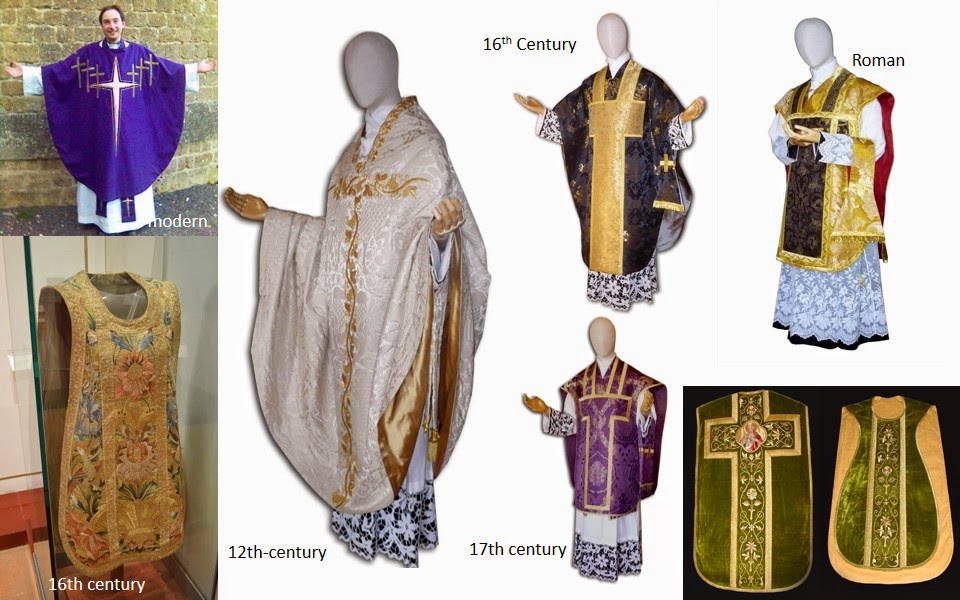
The chasuble originated as a sort of conical poncho, called in Latin a "casula" or "little house," that was the common outer traveling garment in the late Roman Empire. It was simply a roughly oval piece of cloth, with a round hole in the middle through which to pass the head, that fell below the knees on all sides. It had to be gathered up on the arms to allow the arms to be used freely.

In its liturgical use in the West, this garment was folded up from the sides to leave the hands free. Strings were sometimes used to assist in this task, and the deacon could help the priest in folding up the sides of the vestment. Beginning in the 13th century, there was a tendency to shorten the sides a little. In the course of the 15th and the following century, the chasuble took something like its modern form, in which the sides of the vestment no longer reach to the ankle but only, at most, to the wrist, making folding unnecessary.

At the end of sixteenth century the chasuble, though still quite ample and covering part of the arms, had become less similar to its traditional shape than to that which prevailed in the nineteenth and early twentieth centuries, when the chasuble was reduced to a broad scapular, leaving the whole of the arms quite free, and was shortened also in front and back. Additionally, to make it easier for the priest to join his hands when wearing a chasuble of stiff (lined and heavily embroidered) material, in these later centuries the front was often cut away further, giving it the distinctive shape often called "fiddleback". Complex decoration schemes were often used on chasubles of scapular form, especially the back, incorporating the image of the Christian cross or of a saint; and rich materials such as silk, cloth of gold or brocade were employed, especially in chasubles reserved for major celebrations.

Current usage

In the twentieth century, there was a tendency to return to an earlier, more ample, form of the chasuble, sometimes called "Gothic", as distinguished from the "Roman" scapular form. This aroused some opposition, as a result of which the Sacred Congregation of Rites issued on 9 December 1925 a decree against it, which it explicitly revoked with the declaration Circa dubium de forma paramentorum of 20 August 1957, leaving the matter to the prudent judgement of local Ordinaries. There exists a photograph of Pope Pius XI wearing the more ample chasuble while celebrating Mass in Saint Peter's Basilica as early as 19 March 1930

After the Second Vatican Council the more ample form became the most usually seen form of the chasuble, and the directions of the GIRM quoted above indicate that "it is fitting" that the beauty should come "not from abundance of overly lavish ornamentation, but rather from the material that is used and from the design. Ornamentation on vestments should, moreover, consist of figures, that is, of images or symbols, that evoke sacred use, avoiding thereby anything unbecoming" (n. 344). Hence, the prevalence today of chasubles that reach almost to the ankles, and to the wrists, and decorated with relatively simple symbols or bands and orphreys. By comparison, "fiddleback" vestments were often extremely heavily embroidered or painted with detailed decorations or whole scenes depicted.
Pop Benedict XVI

Use of scapular "Roman" chasubles, whether with straight edges or in "fiddleback" form, is sometimes associated with traditionalism or even rebellion against the reforms of the Second Vatican Council. However, some priests prefer them simply on grounds of taste and comfort, while for similar reasons some traditionalist priests prefer ampler chasubles of less stiff material.

Pope Benedict XVI has sometimes used chasubles of the transitional style common at the end of the 16th century.


In the Slav tradition, though not in the Greek, the phelonion, the Byzantine Rite vestment that corresponds to the chasuble, is cut away from the front and not from the sides, making it look somewhat like the western cope.

Alb Gowns(2)

8/24/2014 Add Comment

Alb


The alb (from the Latin Albus, meaning white), one of the liturgical vestments of the Roman Catholic, Anglican, Lutheran, and many Methodist churches, is an ample white garment coming down to the ankles and is usually girdled with a cincture. It is simply the long, white linen tunic used by the Romans.

As a simple derivative of ordinary first-century clothing, the alb was adopted very early by Christians, and especially by the clergy for the Eucharistic liturgy. In early Medieval Europe it was also normally worn by secular clergy in non-liturgical contexts


Nowadays, the alb is the common vestment for all ministers at Mass, both clerics and laypersons, and is worn over the cassock and under any other special garments, such as the stole, dalmatic or chasuble. If the alb does not completely cover the collar, an amice is often worn underneath the alb. The shortening of the alb for use outside a church has given rise to the surplice, and its cousin the rochet, worn by canons and bishops. Post-Tridentine albs often were made with lace. Since then, this detail has fallen out of style, except in parts of the Anglo-Catholic movement and some very traditional Roman Catholic parishes. In many Anglican parishes, the alb is decorated with apparels. In most high Anglican churches, the Alb is an undergarment worn under the vestments. In some lower and broad Anglican churches, the alb is considered liturgical everyday wear

Variants

A chasuble-alb is a contemporary Eucharistic vestment that combines features of the chasuble and alb. In the Roman Catholic Church, it was first adopted in France, though without official approval. In France it is no longer fashionable, but it has been officially approved in some tropical countries such as the Philippines.  It is always white in colour. A stole of the colour appointed for the Mass of the day is worn outside it, in place of the normal white alb and coloured chasuble.

A cassock-alb is a vestment that combines features of the cassock and alb. It developed as a more convenient undergarment worn by clergy and as an alternative to the alb for deacons and acolytes.

Academic Gowns(1)

8/24/2014 1 Comment

Academic Gowns 


Academic dress is a traditional form of clothing for academic settings, primarily tertiary (and sometimes secondary) education, worn mainly by those who have been admitted to a university degree (or similar), or hold a status that entitles them to assume them (e.g., undergraduate students at certain old universities). It is also known as academicals and, in the United States, as academic regalia.


Contemporarily, it is commonly seen only at graduation ceremonies, but formerly academic dress was, and to a lesser degree in many ancient universities still is, worn daily. Today the ensembles are distinctive in some way to each institution, and generally consists of a gown (also known as a robe) with a separate hood, and usually a cap (generally either a square academic cap, a tam, or a bonnet). Academic dress is also worn by members of certain learned societies and institutions as official dress.

Overview

The academic dress found in most universities in the Commonwealth of Nations and the United States is derived from that of the universities of Oxford and Cambridge, which was a development of academic and clerical dress common throughout the medieval universities of Europe.

Formal or sober clothing is typically worn beneath the gown so, for example, men would often wear a dark suit with a white shirt and a tie, or clerical clothing, military or civil uniform, or national dress, and women would wear equivalent attire. Some older universities, particularly Oxford and Cambridge, have a prescribed set of dress (known as subfusc) to be worn under the gown. Though some universities are relaxed about what people wear under their gowns, it is nevertheless considered bad form to be in casual wear or the like during graduation ceremonies, and a number of universities may bar finishing students from joining the procession or the ceremony itself if not appropriately dressed. In the Commonwealth, gowns are worn open, while in the United States it has become common for gowns to close at the front, as did the original roba.


Materials

In general, the materials used for academic dress are heavily influenced by the climate where the academic institution is located, or the climate where the graduate will usually be wearing the costume.

The materials used for academic dress vary and range from the extremely economical to the very expensive. In the United States, most Bachelor and Master degree candidates are often only presented the "souvenir" version of regalia by their institutions or authorized vendor, which are generally intended for very few wearings and are comparatively very inexpensive. For some doctoral graduates commencement will be the only time they wear academic regalia, and so they rent their gowns instead of buying them. These rented (or hired) gowns are often made of inexpensive polyester or other man-made synthetic fibre. In Britain, rented gowns are almost always polyester while Russell cord, silk or artificial silk gowns are only available when bought. Undergraduate gowns are usually made from cotton or cotton and polyester mix and are relatively inexpensive to encourage students to own them.

People who choose to buy their dress may opt for finer fabrics, such as princetta, poplin, grosgrain, Percale, cotton, wool, cassimere, broadcloth, bengaline, Russell cord or corded/ribbed material. For silk, there are a range of types including artificial silk/rayon, ottoman (i.e. ribbed or corded silk), taffeta, satin, alpaca, true silk, shot silk or a mixture. Pure ottoman silk is rarely used except for official gowns as it is very expensive. Some gowns may be trimmed with gimp lace, cords, buttons or other forms of decoration.

Academic dress by country


Canada

In Canada, academic regalia is worn by university officials, faculty, students and honored guests during commencement exercises, installations of their presiding officers and special convocations, such as the inauguration of newly endowed professorial chairs and inductions to some of the honor and professional societies with university chapters.


Academic regalia typically consists of a headgear (mortarboard, Tudor bonnet or John Knox cap), robe and hood. Until the 1930s, Canadian universities customarily prescribed academic robes for its professors and students at classes and lectures. At the University of Trinity College at the University of Toronto academic gowns are still required for all students and faculty at weekday dinners, most college meetings, debates and certain special college events. 


France

In France, academic dress, also called the toge is similar to French judges' court dress, except for its colour, which depends on the academic field in which the wearer graduated. It is nowadays little worn, except by doctors during the opening of the university year or the ceremony for a doctorate honoris causa. For doctors, it consists of:


a long gown (a bit similar to a cassock) with a long row of buttons (traditionally, 33, but nowadays usually fewer) in front and a train at the back (which in the current costume is not visible but attached with a button in the inner side of the gown). The gown is in two colours: black and the standard colour of the academic field in which the wearer graduated (see below), with simarras (two vertical bands in the front of the gown).
an épitoge (epitoga): a piece of cloth with white fur stripes (three for doctors) attached by a button on the left shoulder, with a rectangular, long, thin tail in the front and a triangular, shorter, broad tail in the back (both tails carry the fur stripes); its colour is that of the relevant academic field. The epitoga has evolved from the academic hood, which explains why the French academic dress does not include a hood.
a long, wide belt or sash, either black or of the colour of the relevant academic field, ended by fringes (which may be golden or of the same colour as the belt), and attached with a broad ornamental knot.
a white rabat (jabot), over which a white tie may be worn for ceremonial occasions. It is made of lace for the Dean of the Faculty, the President of the University, and a few other officials; of plain cotton for others.
only for men, a mortarboard of the colour of the relevant academic field with a golden stripe, which is usually not worn but carried (since anyway the academic dress in France is rarely worn outdoors, and men are supposed not to wear hats indoors), and often even omitted.
in principle white bow tie and white gloves.


Germany

The German academic dress is called "Talar" (with the accent on the second "a": talár; from Latin talare which means to the ankles), and can be described as the normal black long gown with wide sleeves common to all scholars in Europe and America. It can be traced back to the every day clothes of the scholars in the Middle Ages. The same word Talar is also used for the robes of Protestant (Lutheran) pastors and rabbis (not for judges or lawyers, their gowns are called "Robe"), although these gowns often differ more or less in cut, length, drappings, and sometimes even in colour (the gowns of the German Supreme Court are, e.g., completely dark red).
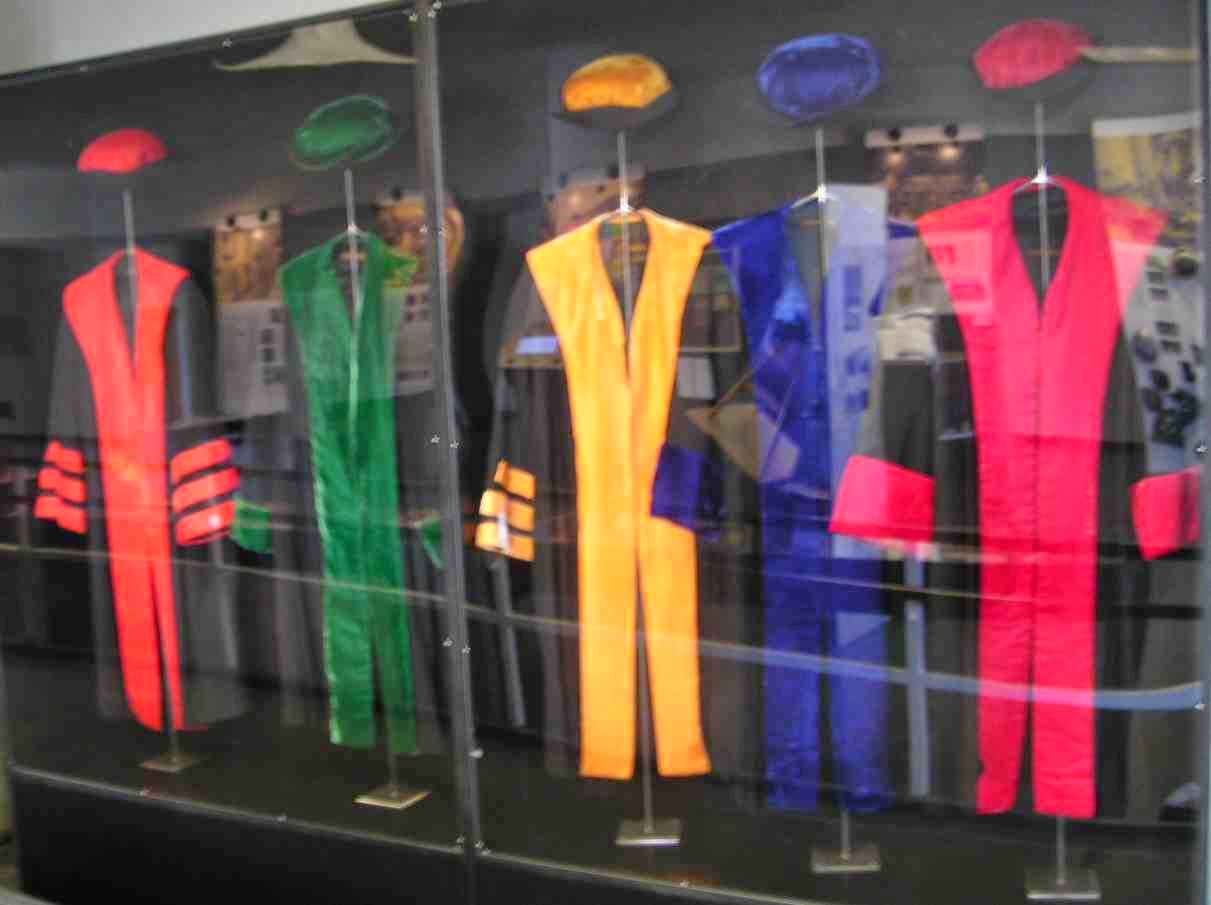

In Germany only the rectors, deans, professors, and lecturers wore the gowns—not students or graduates. Each German university had its own system of colours and drapings, which differs from that of British and American universities (for example, theology is normally not bright red but dark purple, similar to the French system). After the so-called "student's revolution" following the years of 1967, all German universities dropped their academic dress because they were identified with right-winged conservatism and reactionism by the mostly socialist influenced students at that time: The famous slogan "Unter den Talaren – Muff von 1000 Jahren" (beneath the gowns the fug of 1000 years) refers not only to the old traditions of the Middle Ages, but also to the Nazi regime and their self-declared "empire of 1000 years"

Italy

In Italy there are several differences among the typical academic dress (gowns, academic caps, etc.) of the different universities, due to the great number of ancient universities in the country. Usually gowns are worn only by professors during ceremonies and, in some faculties, during graduations. After the student protests of 1968 many professors in many universities had stopped wearing academical gowns also in the formal occasions but since the nineties people have started to use them again, mostly in humanities faculties. Furthermore also students have started to wear gowns and cap in graduation ceremonies (usually for Ph.D.) in some universities. Gowns are traditionally all hemmed with the colours of faculty, which have some variations following the tradition of each atheneum. However the most widely used table of coulours is the following


FacultyColourSample
HumanitiesWhite
Architecture and EngineeringBlack
EconomicsYellow
LawBlue
PharmacyMaroon
Political scienceLilac
EducationPink
MedicineRed
Veterinary medicineViolet
Natural scienceGreen
PsychologyGrey
SociologyOrange

New Zealand

University graduates in New Zealand wear an academic gown identical to those of the University of Cambridge and either a hood or scarf, depending on whether the graduate is receiving a degree or diploma. If the graduate is receiving a degree, a hood will be worn throughout the ceremony. If a diploma is received, the graduate will wear a diploma scarf.


The hood, like the gown, is identical to that of the hood for the Cambridge Master of Arts. A Bachelor's degree hood is lined with coloured satin and bordered with white fur (the exception to this are Canterbury and Waikato University which do not line their hoods with fur). The Bachelor's degree with Honours hood is lined with coloured satin and bordered with white satin. The Master's degree hood has no edging. A Doctoral Degree recipient wears the same as a graduate receiving a Masters, except the gown is completely silk, either black or scarlet, with the option to wear a cloth gown. A Doctoral hood is completely silk and the headdress is a black Tudor bonnet, in place of the flat-topped mortarboard worn with Bachelor's and Master's gowns .

FacultyColourSample
ArchitectureLemon
ArtsPink
BBIMApricot
Business Administration, MBABurgundy
CommerceOrange
DentistryViolet
EconomicsCopper
EducationEmerald, Coral
EngineeringDark Violet
Fine Arts,Gold
Human BiologyCrimson
LawLight Blue
MedicineLilac
MusicWhite
NursingNavy
OptometryBlue Green
Performing ArtsPink
PharmacyGrey Green
PhilosophyDark Blue
Physical EducationSage Green
PlanningGreen
PropertySilver
ScienceDark Blue
Theology, DivinityForest Green, Violet Grey

Portugal

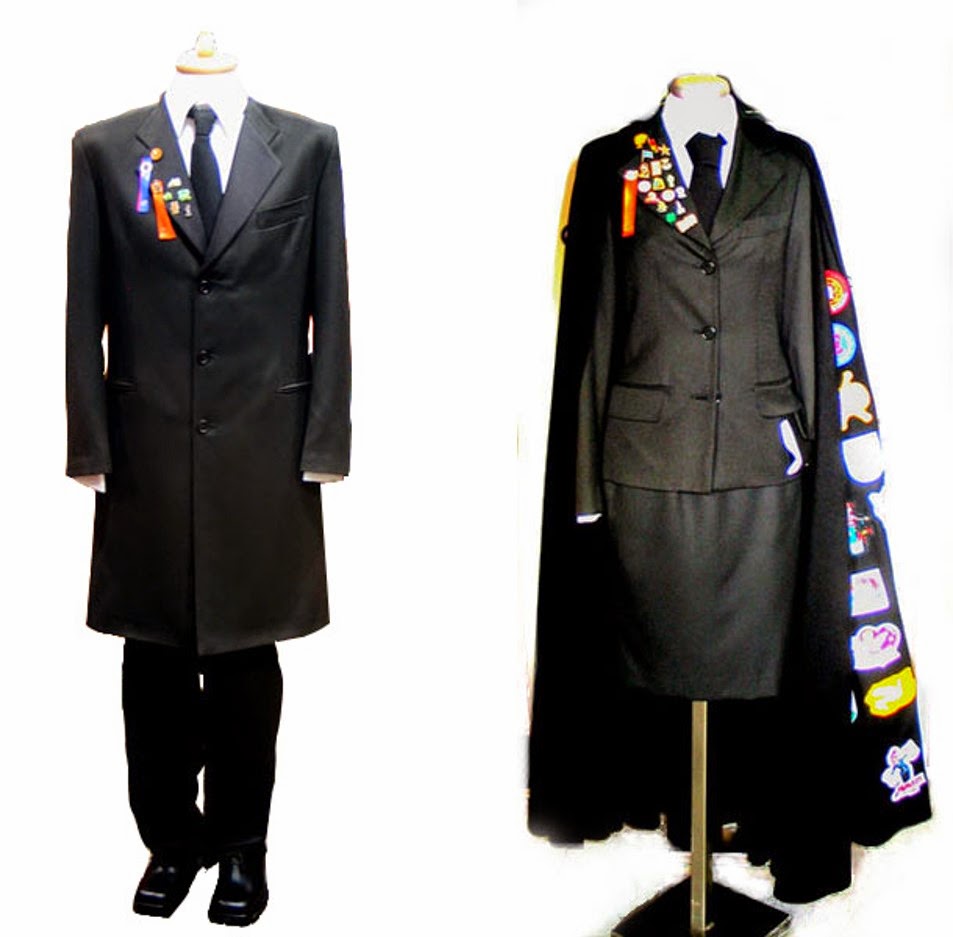
In most Portuguese universities and other types of higher education institutions, usage of academic dress for undergraduates, or traje académico is still widespread and has even gained popularity in recent decades. The traje is composed of black trousers (or skirt, for female students), white shirt, black tie, a black overcoat, known as batina (in the case of male students, the classical traje also includes a black vest) and a black robe. Some Portuguese higher education institutions have their typical academic outfit which differs greatly from that born in the ancient University of Coimbra. This is the case, for example, of those worn by the students of the University of the Algarve and Minho University. Usage is generally restricted to the first weeks of the semester, during the introductory and reception activities which make part of the Praxe tradition. In some older institutions, where traditions are better implemented, one can see students trajados during the entire year, though.


United States

Academic regalia in the United States has been influenced by the academic dress traditions of Europe. There is an Inter-Collegiate code which sets out a detailed uniform scheme of academic regalia followed by most, though some institutions do not adhere to it entirely, and fewer still ignore it.

The practice of wearing academic regalia in the United States dates to the Colonial Colleges period, and was heavily influenced by European practices and styles. Students of most colonial colleges were required to wear the "college habit" at most times – a practice that lasted until the eve of the American Civil War in many institutions of higher learning. In some rare instances the practice has persisted, such as at Sewanee, where members of one student society continue to wear the gown to class. After the Civil War, academic regalia was generally only worn at ceremonies or when representing the institution. There was not, however, any standardization among the meanings behind the various costumes. In 1893, an Intercollegiate Commission made up of representatives from leading institutions was created, to establish an acceptable system of academic dress. The Commission met at Columbia College (now Columbia University) in 1895 and adopted a code of academic regalia, which prescribed the cut and style and materials of the gowns, as well as determined the colours which were to represent the different fields of learning. In 1932 the American Council on Education (ACE) authorized the appointment of a committee


to determine whether revision and completion of the academic code adopted by the conference of the colleges and universities in 1895 is desirable at this time, and, if so, to draft a revised code and present a plan for submitting the code to the consideration of the institutional members of the Council.

The committee reviewed the situation and approved a code for academic costumes that has been in effect since that year. A Committee on Academic Costumes and Ceremonies, appointed by the American Council on Education in 1959, again reviewed the academic dress code and made several changes.

Although academic dress is now rarely worn outside commencement ceremonies or other academic rituals such as encaenia in the U.S. graduation ceremonies have gained popularity and have expanded from high school graduations to middle school, elementary school and kindergarten graduation ceremonies.

Bachelors' and masters' gowns in the United States are similar to their counterparts in the United Kingdom, though bachelor's gowns are now designed to be worn closed, and all are at least mid-calf length to ankle-length. The masters' gown sleeve is oblong and, though the base of the sleeve hangs down in the typical manner, it is square cut at the rear part of the oblong shape. The front part has an arc cut away, and there is a slit for the wrist opening, but the rest of the arc is closed. The shape is evocative of the square-cut liripipe incorporated into many academic hoods (see, below). The master's gown is designed to be worn open or closed.

Doctoral robes are typically black, although some schools use robes in the school's colours. The Code calls for the outside shell of the hood (see, below) to remain black in that case, however. In general, doctoral gowns are similar to the gowns worn by bachelor's graduates, with the addition of three velvet bands on the sleeves and velvet facing running down the front of the gown. The Code calls for the gown trim to be either black or the colour designated for the field of study in which the doctorate was earned (see Inter-Collegiate colors). However, it should be noted that in the case of the degree of Doctor of Philosophy (PhD), although it is awarded for study in any number of fields, the dark blue velvet of philosophy is always used regardless of the particular field studied. For example, if not choosing black trim, a PhD in theology would wear velvet gown trim in dark blue, while a Doctor of Theology (Th.D.) would wear scarlet trim, if not choosing black. The robes have full sleeves, instead of the bell sleeves of the bachelor's gown. Some gowns expose a necktie or cravat when closed, while others take an almost cape-like form. It is designed to be worn open or closed in the front.

The Code calls for the shell material of the hood to match the robe, and for the colour to be black regardless of the colour of the robe being worn. The interior lining – generally silk – displays the colours of the institution from which the wearer received the degree, in a pattern prescribed by it (usually, if more than one colour is used, chevrons or equal divisions). The opening of the hood is trimmed in velvet or velveteen. In most American colleges and universities, the colour of the velvet hood trimming is distinctive of the academic field – or as closely related as possible – to which the degree earned pertains (see Inter-Collegiate colors). Many institutions, particularly larger ones, have dispensed with the bachelor's hood at commencement ceremonies altogether, though a graduate is still entitled to wear one once the degree is conferred.

Headwear is an important component of cap-and-gown, and the academic costume is not complete without it. The headwear will vary with the level of academic achievement and, to some extent, on the individual academic institution's specifications. For caps, the mortarboard is recommended in the Code, and the material required to match the gown. The exception—velvet—is reserved for the doctor's degree only, seen in the form of a multiple-sided (4, 6, or 8) tam, but the four-sided mortarboard-shaped tam in velvet is what the Code seems to recommend here. The only colour called for is black, in all cases. The tassel worn on the mortarboard or a tam seems to provide, by tradition, the greatest opportunity for latitude in American academic dress. It has been black, or represented the university's colours, or the colours of the specific college, or the discipline. The tassel has also been used to indicate membership in national honour societies or other awards. There is at some colleges and universities a practice of moving the tassel from one side to the other on graduating, but this is a modern innovation that would be impractical out of doors due to the vagaries of the wind. For doctoral and masters students, the tassel commonly begins and remains on the left.
Tunisian
The colours allocated to the various fields of learning have been largely standardized in the United States by the Intercollegiate Bureau of Academic Costume, and accepted by the American Council on Education in its Academic Costume Code. Some of the more common colours seen are that liberal arts is represented by white, science by golden yellow, medicine by green, law by purple, and philosophy (including all PhD degrees) by dark blue. A distinction is made in the code, which calls for a graduate to display the colour of the subject of the degree obtained, not the degree itself. For example, if a graduate is awarded a Bachelor of Arts (BA) degree specifically in business the trimming should be drab, representing commerce/accountancy/business, rather than white, representing the broader arts/letters/humanities; the same method is true of master's degrees and doctorates. However, in 1986, the American Council on Education updated the Code and added the following sentence clarifying the use of the colour dark blue for the Doctor of Philosophy degree, which is awarded in any number of fields: "In the case of the Doctor of Philosophy (Ph.D.) degree, the dark blue colour is used to represent the mastery of the discipline of learning and scholarship in any field that is attested to by the awarding of the degree, and it is not intended to represent the field of philosophy."

A number of other items such as cords, stoles, aiguillettes, etc. representing various academic achievements or other honours are also worn at the discretion of some degree-granting institutions. Technically, however, the ACE code does not allow their use on or over academic regalia.




Wrapper (clothing) Dress(77)

8/22/2014 Add Comment

Wrapper (clothing)


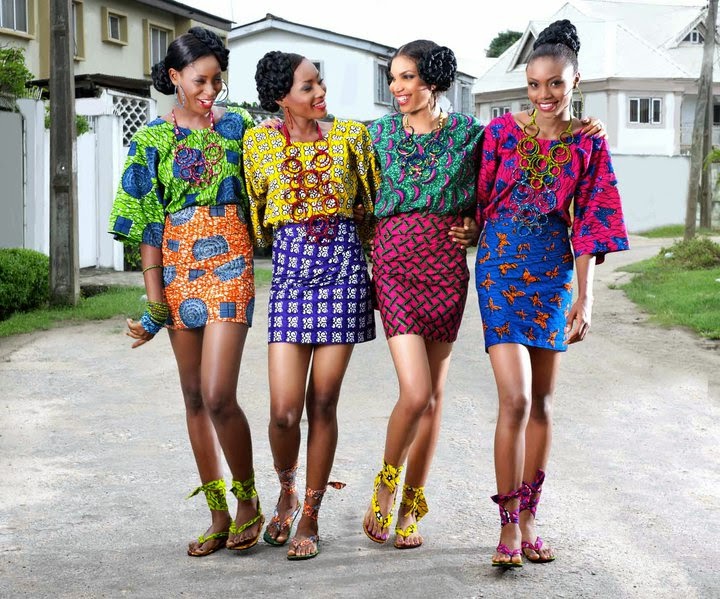
The wrapper or pagne is a colorful women's garment widely worn in West Africa. It has formal and informal versions and varies from simple draped clothing to fully tailored ensembles. The formality of the wrapper depends on the fabric used to create it.

West African kaftan/boubou

In West Africa, a kaftan or caftan is a pull-over woman's robe. In French, this robe is called a boubou, pronounced boo-boo. The boubou is the traditional female attire in many West African countries including Senegal, Mali, and Ghana. The boubou can be formal or informal attire. The formality of the kaftan depends upon the fabric used to create it.


Nigerian iro

In Nigeria (also in West Africa) the wrapper is most common, called an iro in the Yoruba language, pronounced EE-roe. The wrapper is usually worn with a matching headscarf or head tie that is called a gele in Yoruba, pronounced gae-lae. A full wrapper ensemble consists of three garments. First, a blouse, called a buba, pronounced boo-bah. Second, a wrap skirt called a wrapper in English or an iro in Yoruba. Third, a headscarf which is called a head tie in English and a gele in Yoruba. Traditional male attire is called a dashiki. A wrapper takes metres of quality fabric. White wrapper sets are worn during wedding ceremonies.

Pagne

Pagne designates a certain cut (two by six yards) and type (single-sided "Fancy" or double-sided "wax" prints) of untailored cotton textile, especially in Francophone West and Central Africa. Enormously popular in much of tropical Africa, the pagne cloth's usage and patterns may be used to by convey by the wearer a number of social, economic—and sometimes even political—messages. It is similar—though distinct in size, expected pattern, and usage—to the Khanga, Kikoy or Chitenge of East and Southern Africa. From the pagne any number of garments may be created (the boubou, dresses, or western style suits) or it can be used untailored as a wrap, headtie, skirt, or tied as a sling for children or goods. The word pagne, likely derived from the Latin pannum, was a term introduced by merchants from the 16th Century and adopted by several African societies to identify often pre-existing textiles or garments distinct from a simple cloth. The Portuguese pano for cloth has become the French pagne (loincloth), Dutch paan, and others. It appears to have originally referred to East Asian textiles traded in East and West Africa, before becoming a term for a certain length (a yard, later two by six yards) of commercial printed cloth sold in coastal West Africa.


In the West

The wrapper gained popularity in the West following the black pride movement of the 1960s. It is enjoying a resurgence thanks to African immigration, and the formal wrapper is frequently worn at weddings, graduations and other special occasions.

In the UK and North America, a wrapper is also an older term for an informal house garment. Today, words such as housecoat and bathrobe (US) or dressing gown (UK) are usually employed instead.

Informal fabrics USed

  • Batik—created with hot wax and dye.
  • Fancy print—created by printing patterns on cloth. Unlike expensive wax prints, the design is printed on one side of the cotton fabric. Fancy prints are made in Europe, India, and West Africa. The most popular fancy print is known as the traditional print.
  • Kente—traditionally woven by men. Kente is an informal fabric for anyone who is not a member of the Akan people. For Akans and many Ewes, kente is a formal cloth.
  • Mudcloth—created by making mud drawings on cotton.
  • Tie-dye—made by resist tying cotton then dipping in dye. In Nigeria, tie-dye is known as adire cloth.


Formal fabrics

  • Aso Oke fabric—Woven by men, see Yoruba people.
  • Cotton brocade—most brocade is produced in Guinea. Brocade is a shiny and polished cotton fabric.
  • George cloth—George cloth originated in India, where it was used to make saris. The fabric became popular among African royal and noble families. The Ijaw people  are known for their George wrappers.
  • Lace—also known as shain-shain aso oke or air conditioner aso oke.
  • Linen—linen kaftans are a formal style.
  • Satin—satin fabrics are suitable for formal wear.
  • African waxprints—traditional cloths in Africa. Most of them are printed in West Africa and China. Some African waxprints are made in the Netherlands, known as Dutch wax. In earlier times there were also productions in England. In a waxprint, the pattern or design is printed on both sides of the cotton fabric. Waxprints are more expensive than fancy prints. Famous manufacturers are Vlisco in the Netherlands, Akosombo Textiles Limited in Ghana and Hitarget in China. There still exist some smaller companies, which produce genuine African waxprints. A well known brand is ABC Wax from Manchester, England. Today ABC Wax is part of Akosombo Textiles Limited and printed in Ghana. There exist many companies in Africa and China, which use the waxprint design for similar looking and much cheaper fancy textiles.


Wedding attire

The kaftan is always worn with a headscarf or head tie. During a wedding ceremony, the bride's kaftan is the same color as the groom's dashiki. The traditional color for West African weddings is white.[14] The most popular non-traditional color is purple or lavender, the color of African royalty. Blue, the color of love, is also a common non-traditional color. Most women wear black kaftans to funerals. However, in some parts of Ghana and the United States, some women wear black-and-white prints, or black and red. The kaftan is the most popular attire for women of African descent throughout the African diaspora. African and African-American women wear a wide variety of dresses, and skirt sets made out of formal fabrics as formal wear. However, the kaftan and wrapper are the two traditional choices. It is not uncommon for a woman to wear a white wedding dress when the groom wears African attire. In the United States, African-American women wear the boubou for special occasions. The kaftan or boubou is worn at weddings; funerals; graduations; and Kwanzaa celebrations.

The men's robe is also called a boubou, see Senegalese kaftan for further information.

Buba

A buba (pronounced boo-bah) is a woman's blouse. Buba is a Yoruba word that means blouse. The buba can be worn informally with pants or a fancy print wrapper. When worn as formal wear, the buba is paired with a skirt or wrapper made of formal fabrics. The informal dashiki, or men's shirt, is unisex and is also worn by women.[where?] The dashiki and buba differ in that the dashiki is boxy and baggy with a straight bottom, whereas, the buba is fitted with a curved bottom, or baggy with a V shaped bottom. Like the dashiki, the buba comes in long, and short sleeve versions. The buba and skirt set or buba and wrapper set is the national costume of many West African countries.


Wedding Dress (75)

8/19/2014 4 Comments

Wedding Dress


A wedding dress or wedding gown is the clothing worn by a bride during a wedding ceremony. Color, style and ceremonial importance of the gown can depend on the religion and culture of the wedding participants. In Western cultures, brides often choose a white wedding dress, which was made popular by Queen Victoria in the 19th century. In eastern cultures, brides often choose red to symbolize auspiciousness.

Western culture

Weddings performed during and immediately following the Middle Ages were often more than just a union between two people. They could be a union between two families, two businesses or even two countries. Many weddings were more a matter of politics than love, particularly among the nobility and the higher social classes. Brides were therefore expected to dress in a manner that cast their families in the most favorable light and befitted their social status, for they were not representing only themselves during the ceremony. Brides from wealthy families often wore rich colors and exclusive fabrics. It was common to see them wearing bold colors and layers of furs, velvet and silk. Brides dressed in the height of current fashion, with the richest materials money could buy. The poorest of brides wore their best church dress on their wedding day. The amount and the price of material a wedding dress contained was a reflection of the bride's social standing and indicated the extent of the family's wealth to wedding guests.


The first documented instance of a princess who wore a white wedding gown for a royal wedding ceremony is that of Philippa of England, who wore a tunic with a cloak in white silk bordered with grey squirrel and ermine) in 1406.Mary, Queen of Scots, wore a white wedding gown in 1559 when she married her first husband, Francis Dauphin of France because it was her favorite color, although white was then the color of mourning for French Queens.

This was not a widespread trend, however: prior to the Victorian era, a bride was married in any color, black being especially popular in Scandinavia.

White became a popular option in 1840, after the marriage of Queen Victoria to Albert of Saxe-Coburg, where Victoria wore a white gown to incorporate some lace she prized. The official wedding portrait photograph was widely published, and many brides opted for white in accordance with the Queen's choice.

Even after that, for a period, wedding dresses were adapted to the styles of the day. For example, in the 1920s, they were typically short in the front with a longer train in the back and were worn with cloche-style wedding veils. This tendency to follow current fashions continued until the late 1960s, when it became popular to revert to long, full-skirted designs reminiscent of the Victorian era.

Today, Western wedding dresses are usually white though "wedding white" includes shades such as eggshell, ecru and ivory.

Later, many people assumed that the color white was intended to symbolize virginity, though this was not the original intention: it was the color blue that was connected to purity, piety, faithfulness, and the Virgin Mary

Current fashion

About 75 percent of wedding dresses on the market are strapless dresses or sleeveless, in part because such dresses require less skill from the designers and are easier to alter to fit correctly. However, the sleeved wedding gown as well as wedding gowns with straps have both become more popular in recent years.

Eastern culture

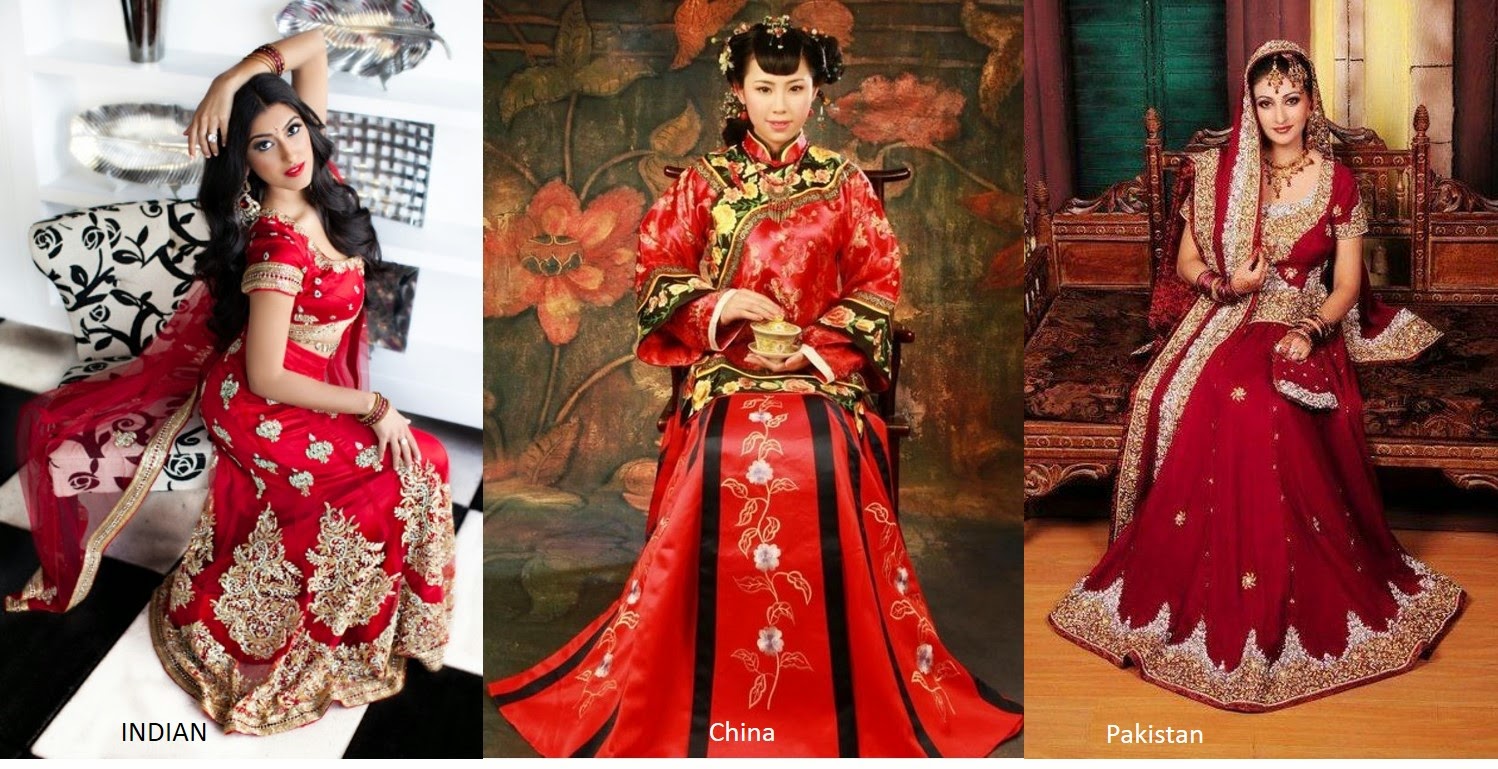
Many wedding dresses in China, India (wedding sari), Pakistan and Vietnam (in the traditional form of the Ao dai) are red, the traditional colour of good luck and auspiciousness. Nowadays, many women choose other colours besides red. In modern mainland Chinese weddings, the bride may opt for Western dresses of any colour, and later don a traditional costume for the official tea ceremony.

In modern Taiwanese weddings, the bride generally picks red (following Chinese tradition) or white (more Western) silk for the wedding gown material, but most will wear the red traditional garment for their formal wedding banquets. Traditionally, the father of the bride is responsible for the wedding banquet hosted on the bride's side and the alcohol (specifically called "xi-jiu," confusingly the same as what the wedding banquet itself is called) consumed during both banquets. While the wedding itself is often based on the couple's choices, the wedding banquets are a symbolic gesture of "thanks" and appreciation, to those that have raised the bride and groom (such as grandparents and uncles) and those who will continue to be there to help the bride and groom in the future. Thus out of respect for the elders, wedding banquets are usually done formally and traditionally.


Red wedding saris are the traditional garment choice for brides in Indian culture. Sari fabric is also traditionally silk. Over time, colour options and fabric choices for Indian brides have expanded. Today fabrics like crepe, Georgette, charmeuse, and satin are used, and colors have been expanded to include gold, pink, orange, maroon, brown, and yellow as well. Indian brides in Western countries often wear the sari at the wedding ceremony and change into traditional Indian wear afterwards.

At Japanese weddings, brides will often wear three or more dresses throughout the ceremony and subsequent celebrations with a traditional kimono, white and colour dress combination being popular. White is used, because in Japan it symbolises death—in this case, the bride becomes dead to her family[citation needed]. The bride will eventually remove her white kimono to reveal another colored one—usually red—to symbolize her rebirth into her husband's family.

The Javanese people of Indonesia wear a kebaya, a traditional kind of blouse, along with batik.


In the Philippines, variations of the Baro't saya adapted to the white wedding tradition are considered to be wedding attire for women, along with the Barong Tagalog for men. Various tribes and Muslim Filipinos don other forms of traditional dress during their respective ceremonies

Native American culture

The indigenous peoples of the Americas have varying traditions related to weddings and thus wedding dresses. A Hopi bride traditionally had her garments woven by the groom and any men in the village who wished to participate. The garments consisted of a large belt, two all-white wedding robes, a white wedding robe with red stripes at top and bottom, white buckskin leggings and moccasins, a string for tying the hair, and a reed mat in which to wrap the outfit. This outfit also served as a shroud, since these garments would be necessary for the trip through the underworld.

A Pueblo bride wore a cotton garment tied above the right shoulder, secured with a belt around the waist.


In the traditions of the Delaware, a bride wore a knee-length skirt of deerskin and a band of wampum beads around her forehead. Except for fine beads or shell necklaces, the body was bare from the waist up. If it were a winter wedding, she wore deerskin leggings and moccasins and a robe of turkey feathers. Her face was painted with white, red and yellow clay.

The tribes of Northern California (which include the Klamath, the Modoc and the Yurok) had a traditional bridal dress woven in symbolic colors: white for the east, blue for the south, yellow (orange) for the west; and black for the north. Turquoise and silver jewelry were worn by both the bride and the groom in addition to a silver concho belt. Jewelry was considered a shield against evils including hunger, poverty and bad luck.

source Wikipedia, a detailed study on every terms and session will follow,