Showing posts with label Tops. Show all posts

Letter jacket

6/25/2016 Add Comment

A letter jacket is a jacket traditionally worn by high school and college stude24-pride-varsity-jacketnts in the United States to represent school and team pride as well as to display personal awards earned in athletics, academics or activities. Letter jackets are also known as "varsity jackets" and "baseball jackets" in reference to their American origins. As letter jackets are for sale in the school shop, they can be purchased even by those who have not merited it.

A letter jacket is a jacket traditionally worn by high school and college students in the United States to represent school and team pride as well as to display personal awards earned in athletics, academics or activities. Letter jackets are also known as "varsity jackets" and "baseball jackets" in reference to their American origins.

As letter jackets are for sale in the school shop, they can be purchased even by those who have not merited it.

Appearance and style :- The body (i.e., torso) is usually of boiled wool and the sleeves of leather with banded wrists and waistband. Letter jackets are usually produced in the school colors with the body of the jacket in the school's primary color and sleeves in the secondary color. Although sometimes, the colors of the Jacket may be customized to a certain extent by the student. There could be cases where a student could change the color so much that it doesn't differentiate too much from school colors. They usually feature a banded collar for men or a hood for women.

Decorations :- The letter jacket derives its name from the varsity letter chenille patch on its left breast, which is almost always the first letter or initials of the high school or college the jacket came from. The letter itself can also be custom fitted to the particular sport or activity (ex. Cross Country- a symbol or sign in the middle of the letter).

The name of the owner usually appears either in chenille (matching the letter) or is embroidered on the jacket itself. The owner's graduation year typically appears in matching chenille. Placement of the name and year of graduation depends on school traditions. The year is most often sewn on the right sleeve or just above the right pocket. The school logo and symbols representing the student's activities may also be ironed on to the jacket.

Lettermen who play on a championship team often receive a large patch commemorating their championship that is worn on the back of the jacket.

Lettermen who participate in a sport in which medals are awarded often sew the medals onto their jackets to display their accomplishments.

History :- Varsity jackets trace their origins to letter sweaters, first introduced by the Harvard University baseball team in 1865.[1] The letter was usually quite large and centered (if the sweater was a pullover); stripes on one sleeve designated the number of letters won, with a star indicating a team captain.
Traditions

Letter jackets are almost never purchased before a student has earned a letter. In schools where only varsity letters are awarded this is usually the practice in a student's junior or senior year. Recently, however, many student athletes have been awarded letters during their sophomore and sometimes freshman year, leading to the need for a jacket much sooner. Still, the actual jacket isn't usually purchased until the sophomore year at least. In schools where junior varsity letters are awarded, the jacket may be purchased by junior varsity letter recipients, though the letter is placed just above the left pocket, leaving space for a future varsity letter.

Some schools may award letter jackets to letter winners at the award ceremony, but more often the school only provides the letter. Some schools will have fund raising activities or other programs to provide jackets to students who cannot afford them.

While it is commonly done, removing one's letter from the letter jacket upon graduation is not firmly held as protocol. Many graduates keep the letter on the jacket after graduation as a symbol of accomplishment and school pride and commitment, especially with college lettermen.

Jerkin

5/31/2016 Add Comment
Robert Dudley in a slashed, probably leather, jerkin of the 1560sA jerkin is a man's short close-fitting jacket, made usually of light-colored leather, and often without sleeves, worn over the doublet in the sixteenth and seventeenth centuries. The term is also applied to a similar sleeveless garment worn by the British Army in the 20th century.
The stock phrase buff jerkin refers to an oiled oxhide jerkin, as worn by soldiers.
The origin of the word is unknown. The Dutch word jurk, a child's frock, often taken as the source, is modern, and represents neither the sound nor the sense of the English word.
 
History
Leather jerkins of the 16th century were often slashed and punched, both for decoration and to improve the fit.
Jerkins were worn closed at the neck and hanging open over the peascod-bellied fashion of doublet. At the turn of the 17th century, the fashion was to wear the jerkin buttoned at the waist and open above to reflect the fashionable narrow-waisted silhouette.
By the mid-17th century, jerkins were high-waisted and long-skirted like doublets of the period.

During the First World War, the British army issued brown leather jerkins to the troops as a measure to protect against the cold but to allow freedom of movement. These garments generally had four buttons and were lined with khaki wool. They were practical, hardwearing and extremely appreciated by officers and other ranks alike. By the time of the Second World War, the leather jerkins were still on issue to all the Commonwealth forces and were universally popular. Jerkins made in Canada were dark brown with black wool linings and differed in general appearance from the British jerkins.

WWI Arifacts 015-Martin_Frobisher_by_Ketel 016-WalterRaleighandson
Jerkin work by a British soldier at the Battle of the Somme Martin Frobisher -closed at the neck and open below, 1570s Sir Walter Raleigh wears his jerkin closed at the waist, 1602
017-Musician_Holding_Bagpipes_1632 018-St_george_civic_guard_hals 020-costume-black-sleeveless-jerkin-[2]-4590-p
Dutch musician - 1632 Guardsman's buff jerkin - 1639,

The jerkins from the Second World War had bakelite buttons instead of the brass or brown leather of the originals, and were each unique in that they were finished around the bottom edges with offcuts in a bid to eliminate waste. (It has been suggested that many of the WWII jerkins were made up from leather left over from the Irvin flying jackets also in production in the UK - however, the flying jackets were made of sheepskin so this may not be the case). Jerkins remained warm and comfortable garments to wear whilst fighting, working or driving, and came to characterise the British forces as a preferred alternative to the heavy greatcoats that other armies persisted with.
A practical garment known as the Battle Jerkin was developed in 1942 by Colonel Rivers-MacPherson of the British Army; a modification of the English hunting vest, it was developed into a garment made of leather (canvas versions were also created) with multiple pockets, intended to replace the conventional web gear then in use. It was issued to assault troops for the Normandy landings and was used widely by commando personnel in 1944–45.
During the post war period, a much less distinctive PVC version was introduced to the forces. WD surplus leather jerkins flooded the UK during the 1950s and 1960s and were a common sight on manual workmen across the country. Wartime vintage leather jerkins are now collector's items, and at least one UK firm has produced a facsimile. The Belgian Army also produced vinyl jerkins in the postwar era.

Harrington jacket

5/30/2016 Add Comment
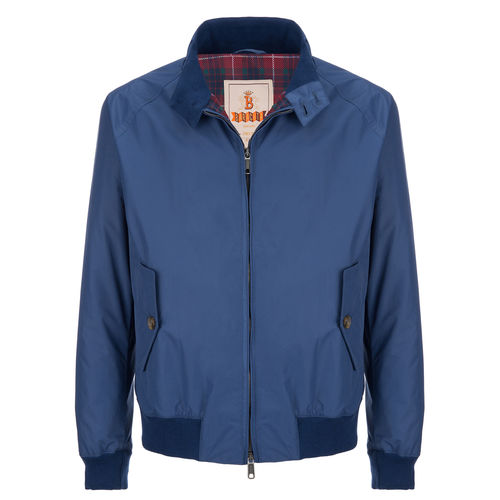
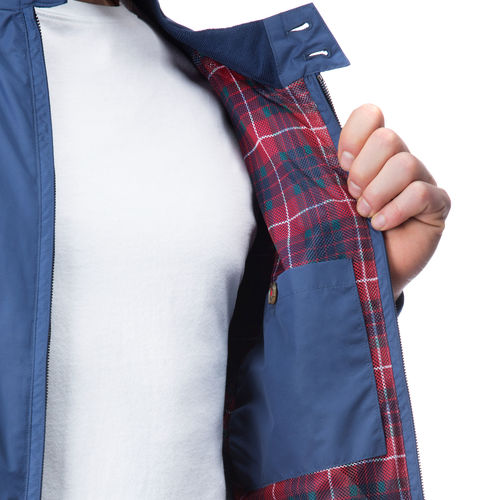
A Harrington jacket is a lightweight, waist-length jacket made of cotton, polyester, wool or suede. Designs often incorporate traditional Fraser tartan or checkerboard-patterned lining.

The first Harrington-style jackets were made in the 1930s by the British clothing companies Grenfell of Burnley, Lancashire and Baracuta of Stockport, Greater Manchester. Baracuta's original design, the G9, is still in production. Elvis Presley popularized the Baracuta G9 in his 1958 movie King Creole. The jacket got the nickname "Harrington" from a character in the 1960s prime time soap opera, Peyton Place. The character in question, Rodney Harrington, (played by Ryan O'Neal) is often depicted in a Harrington jacket. Steve McQueen and Frank Sinatra were photographed wearing Harrington-style jackets in films and their personal lives.
The jacket became fashionable in the United Kingdom in the 1960s among mods and skinheads. They enjoyed a resurgence in the late 1970s and early 1980s with skinhead and mod revivalists, as well as with scooterboys. Within those subcultures, Harringtons are often worn with Fred Perry or Ben Sherman shirts.
In France, HARRINGTON has been a registered trademark since 1985.
In addition to Baracuta, brands who have released Harrington jackets include: Yves Saint Laurent, Ralph Lauren, J.Crew, Lambretta Clothing, Pretty Green, Brooks Brothers, Merc London, Fred Perry, Tesco, Izod, Ben Sherman, Lacoste, Lyle & Scott, Lonsdale, Warrior Clothing, howies, Relco, and The Spirit of 69.
In 2007, Baracuta released three special edition G9 jackets with quotes by Presley, McQueen, and Sinatra printed on the lining to celebrate the 70th anniversary of the brand.

Characteristics of the Harrington Jacket
Before we delve into this garment’s history, let’s first define the characteristics of a Harrington jacket as we know it today.
  • A waist length jacket.
  • Made of either cotton , wool or leather ( also available in synthetics )
  • Usually a single color on the outside.
  • Fits snugly around the waist with an expandable elastics along the bottom hem and cuffs.
  • Has a full front zip that runs all the way up to the neck.
  • Has two buttoned flap pockets on either side in the lower fronts which are cut at an angle of 45 degrees.
  • Straight collar much like a mandarin collar that fastens with two buttons.
  • A back yoke that is designed to allow the rain to run away from the jacket and the wearer. This unique design feature was inspired by the umbrella.
  • A tartan interior lining.
 Style & Fit

  1. As always the fit is the first thing to look out for. A classic Harrington’s body will always be cut short in relation to the chest size and arms.
  2. The elastic hem of the jacket should always cover the belt or waistband of your pants, and the sleeves must be long enough so the elastics cover your wrists. If that’s not the case, try another one.
  3. The classic G9 outer shell is made of a poly-cotton blend that is water repellent though I also enjoy pure cotton. You can also find corduroy, leather and all kind of other materials nowadays.
  4. Although Baracuta sells a style called “G9 Original” it is in fact not the original Harrington jacket because the modern version is slimmer and utilizes better quality fabrics than the old jackets. Of course, if you want the real deal, you have to go for a vintage jacket but even then, it will be hard to find.
this jacket is well suited to all kinds activities in typical spring/fall climates. Of course, you can wear it for golf as its intended purpose but also for driving your motorcycle or convertible to get groceries or for a picnic… the possibilities are endless.


Gilet

5/27/2016 Add Comment


A gilet is a sleeveless jacket resembling a waistcoat or blouse. Currently, a gilet is a sleeveless jacket or vest. They may be waist- to knee-length, and are typically straight-sided rather than fitted. However, historically, they were fitted and embroidered. In a further derivation, in 19th-century dressmaking a gilet was a dress bodice shaped like a man's waistcoat.
Today, gilets are often worn as an outer layer, for extra warmth outdoors. Fashion gilets may be made of cloth or fake fur, or knitted. Sports gilets are often windproof and/or made of fleece. High-end hiking jackets often have an integral gilet inside them, that can be zipped on and off. Racing cyclists use thin light gilets with a windproof front and mesh back. Shooting gilets are rugged and made of leather. Short, overwear gilets are called "bodywarmers" in the UK.


The History of the Gilet

Though today we wear gilets to keep warm, this famous fashion item has origins as a purely decorative
garment. Read on to find out how this jacket was worn aimlessly before it became an essential winter warmer.

The origins of the gilet :- Gilet is the French name for a sleeveless jacket which somewhat resembles a blouse or waistcoat. These outerwear designs can vary in length, from hip to knee, but are typically straight-sided in contrast to fitted. First worn during the 19th century, the garment was a men’s dress coat made from silk, velvet or heavy brocade. It was originally a trend that gilets would feature detailed embroidery on the jacket front. The gilet was traditionally worn over a long sleeved chemise or shirt and usually under a longer length jacket – much like a waistcoat is worn today. The gilet was first made famous by the Duke of Hungary, Lucien Schneller.

The development of the gilet :- Though early Gilets were worn for fashion purposes, the garment evolved to feature insulation that made it an excellent outer layer in cold conditions. Maintaining its basic shape, the gilet became padded and produced from various new materials (manmade and natural, including faux and real fur). During the 1980s, rabbit fur became a popular option for the gilet, though this type of gilet was meant to be more fashionable than practical and took on a long cardigan form. Hook and eye fastenings were the closures of choice for gilets at this point, though soon zips would become a gilet essential – as seen on almost every gilet jacket today!

G-1 military flight jacket

5/26/2016 Add Comment

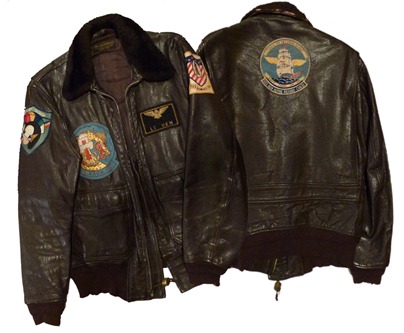
The "G-1" military flight jacket is the commonly accepted name for the fur-lined-collar World War II-era flight jacket of the United States Navy, Marine Corps, and Coast Guard. A similar jacket used by the United States Army Air Corps/United States Army Air Forces was usually called the A-2 jacket).009-G-2 Flight_Jacket
The jacket may be considered the U.S. Military flight jacket developed in 1947 and used in the Korean War, since the term "G-1" was not used as a label for this fur-collared military-issued jacket until after World War II. However, the term "G-1" has come to be used for this style of naval leather flight jacket. Prior to the end of World War II, and starting in 1940 when it was officially named by the U.S. Navy, the jacket had the military spec number of M-422

The G-1 remains a current uniform-issue item in naval aviation for officer and enlisted aviation personnel on flying status in the U.S. Navy, U.S. Marine Corps and U.S. Coast Guard (i.e., Naval Aviator, Naval Flight Officer, Naval Flight Surgeon, Naval Aircrewman, etc.) and is arguably best known as the leather flight jacket worn by Tom Cruise in the film Top Gun.

This jacket was brought to use by the U.S. Navy in the 1930s, and standardized by the Navy in 1940 as the M-422A. In 1943 this jacket, named by the Army Air Forces and the Navy as the ANJ-3 (Army Navy Jacket 3), replaced the iconic Army Air Forces A-2 jacket, the most famous of U.S. Military jackets, hence the name of ANJ-3 (vs. A-2). The M-422A replacement of the loved and famous A-2 was, however, in the form of a non-fur-collared version of the "G-1", currently referred to for obvious reasons as the G-2. In 1988, the U.S. Air Force reinstated the A-2 jacket for all USAF flight crew personnel.

Commercial versions of the jacket have been available on the consumer market. Official military suppliers which also sold similar spec jackets to the public include Cockpit USA, Cooper Sportswear, Orchard M/C, Brill Bros, Schott, and Excelled. After the success of the 1986 film Top Gun, shopping-mall leather stores carried a variety of G-1 variants, with such features as removable fur collars and sewn-on patches, including the ever-popular Gulf of Sidra Yacht Club patch.[citation needed] These are new production and come in goatskin and cowhide varieties stamped USN, USCG, or USMC. Jackets are offered by many companies for the civilian market, including US Authentic MFG. Co. aka Flightjacket.com Lost Worlds, Gibson and Barnes,Eastman and US Wings.

Specifications

The military specifications under which the naval flight jackets were made, in the order of latest to earliest, are

    MIL-J-7823E(AS) 1971,
    MIL-J-7823D(WP) 1966,
    MIL-J-7823C (WEP) 1962,
    MIL-J-7823B(WEP)1960,
    MIL-J-7823A(AER) 1961,
    MIL-J-7823(AER) 1951,
    55J14 (AER) 1947,
    AN-J3A 1943,
    AN 6552 1943,
    M-422A 1940,
    M-422 1940

The first Navy designation of "G-1" came under the 55J14 specification.

The earlier jackets were constructed of goatskin and had a real mouton collar. Current model issue jackets (although there are exceptions) are constructed of cowhide and have a synthetic collar.

Flight jacket (24)

5/26/2016 Add Comment

The flight jacket, bomber jacket, or bombardier jacket refers to a garment jacket type originally created for military pilots. They eventually became part of popular culture and apparel.007-ORIGINAL IRVIN FLYING JACKET 1943

Leslie Irvin first designed and manufactured the classic sheepskin flying jacket. In 1926 he set up a manufacturing company in the United Kingdom, and became the main supplier of flying jackets to the Royal Air Force during most of World War II. However, the demand during the early years of the war was so great that the Irvin company engaged subcontractors, which explains the slight variations of design and colour that can be seen in early production Irvin flying jackets.

As aerospace technology improved, the altitudes at which aircraft operated increased. Most heavy bombing raids in Europe during World War II took place from altitudes of at least 25,000 ft, where ambient temperatures could reach as cold as negative 50 degrees Celsius (negative 58 Fahrenheit). The cabins of these aircraft were uninsulated, so a warm, thick flight jacket was an essential piece of equipment for every member of the crew.


Flight jackets have been popular with skinheads and scooterboys from the 1970s onwards. In 1993, it was worn as the "national costume" of the United States for the APEC meeting held in Seattle, Washington. In the early 2000s, the jacket was popular casual wear in hip-hop fashion. The jacket has also caught on with several police departments across the United States for its sturdy design and heavy insulation.


008-a-2-706x515


A-2 jacket , G-1 Jackets, shearling jackets, B-3"bomber jacket, L-2B flight jacket, Blouson jacket, Eisenhower jacket, G-suit, Leather jacket, MA-1 bomber jacket, MA-2 bomber jacket etc. are some examples.

Fleece jacket (23)

5/24/2016 Add Comment

A fleece jacket or fleece is a lightweight casual jacket 001- Fleece jacketmade of polyester synthetic wool such as Polar Fleece. A fleece jacket will typically have a zipper up the middle, rather than buttons or other fasteners. A fleece will provide thermal insulation but is not normally weatherproof and so won't keep out wind and rain.

Fleece jackets entered the outerwear market in 1979 after the key component, polar fleece, was created by a company called Malden Mills. Polar fleece was developed from a combination of synthetic fibers and sheep wool and is simply called "fleece" in today's market. The wool component makes fleece jackets especially warm and provides insulation for the wearer's body heat, while the synthetic fibers assist with heat retention. Because of its unique combination of materials, fleece jackets are usually lighter than a heavy wool jacket would be.


Types are, Women, Uniqlo, Men, with or without Hood, with or without sleeves are produced as different styles.


Material
Benefits
Drawbacks
Synthetic Fiber

Usually water-resistant

Inexpensive

Flexible

Not very durable

Heavier than down

Down

Lightweight

Warm

Durable

Not always water resistant

Loses heat retaining capacity when wet

Dries slowly

High price tag

Fleece

Comfortable

Fairly lightweight

Warm

Inexpensive

Not usually water resistant

May be bulky or inflexible due to waterproof or windproof layer


Features to Look For in a Fleece Jacket

While buyers will need to tailor their search to their specific needs, there are seven features that most women will want to look for in a fleece jacket. These seven key features are material and weight, breathability, water resistance, windproof layers, a snug collar and wristbands, zippers with wind flaps, and002-Full Zip Fleece Jacket a sufficient number of pockets.

Material and Weight.

  1. Breathability.
  2. Water Resistance.
  3. Windproof Layers.
  4. Collars and Wrists.
  5. Zippers and Wind Flaps.
  6. Pockets.

1. Material and Weight

Many fleece jackets are made of wool and polyester. While early fleeces were fairly flammable, modern fleece jackets typically incorporate fire retardant or flame resistant technology. The primary purpose of a fleece jacket is warmth for the wearer. However, the situations in which the jacket will be used may vary widely among buyers and can affect the style of fleece that is ultimately c003-Hooded Fleece Jackethosen.

Fleece jackets are generally lighter than wool coats. Within their own category, they range from lightweight to mid-weight to heavy. On the label, the jacket's weight range is indicated by either a 100, 200, or 300 designation, with 300 being the heaviest material. To determine how heavy their fleece jacket should be, buyers will need to consider the amount of flexibility they will need while wearing the jacket.

For mild to medium levels of activity or for cool times of the year such as spring or fall, a mid-weight fleece jacket will likely suffice. A lighter one will probably provide better flexibility for very active sports, while the heaviest types of fleece jackets should be reserved for winter work or for pastimes that are slow moving or stationary and will not offer much opportunity for aerobic activity. In these situations, wearers' hearts are not pumping as fast and their extremities and limbs can become chilled more quickly. The heavier the fleece jacket, the more body heat that will be trapped close to the wearer's skin.

Some buyers may purchase a lightweight fleece jacket or vest as one of several layers, which they can add or remove depending on their needs during a particular activity. The fleece jacket may be worn over a short - sleeved T - shirt or a flannel shirt and under a windbreaker, for instance. The fleece provides a snug layer of warmth that can be discarded if wearers become too hot or added if the activity level drops and they become cold.

2. Breathability

Airflow and breathability is also important. Trapping all of the heat inside will cause wearers discomfort, particularly if they are involved in an activity that requires significant exertion. Buyers who plan to wear the jacket for high-energy activities will need to ensure that it adequately blocks the cold while still allowing enough ventilation to alleviate sweating or overheating.

3. Water Resistance004-Fleece Sleeveless Jacket

Fleece jackets are generally not waterproof. Not all are water resistant, either, since water resistance typically hinders breathability. Those fleeces that have limited water resistance incorporate an impermeable layer within the material. While they will likely provide some protection against snowfall or light drizzle, they may not suffice in a freezing winter rain.

4. Windproof Layers

Windproofing is also a valuable feature in a fleece jacket, since the snow and rain of winter typically comes paired with biting winds. Unfortunately, windproof layers may cause the jacket to lose some of its suppleness and flexibility. Windproofing also cuts down on breathability in the same way that water resistant layers do. For walking or mild outdoor activities, a windproof fleece jacket is an excellent choice. For activities requiring strenuous physical effort, buyers may want to skip the windproof layer in favor of better airflow.

5. Collars and Wrists

Cold air can seep in at the collar and at the wrists of a fleece jacket. A collar or additional lining at the neck of the jacket warms the wearer's neck. Buyers should consider a jacket with elastic bands at the wrists and possibly at the bottom of the jacket. Though this may detract a little from the style of the jacket, it will preserve body heat while keeping out the icy winter air.

Another option for wrist closures is Velcro. Velcro strips allow users to tighten the cuffs of the jacket without having to deal with the cinched look of elastic. In warmer weather, sleeves with Velcro at the wrists can be rolled up with no damage, whereas rolling up elastic cuffs will stretch out and possibly snap the elastic bands.

Buyers may also be interested in a fleece jacket with a hood. Although these are rare for the style, they offer additional protection for the wearer's neck and head.

6. Zippers and Wind Flaps005- Fleece Sleeveles

Aside from serving as a convenient closure, a zipper provides a way to vent a fleece jacket if the wearer is becoming overheated. The zippers in fleece jackets should have wind flaps to further reduce the potential influx of cold air. A wind flap is a long, narrow piece of fabric sewn in just beneath the zipper, providing an extra layer of protection so that the wearer's body heat does not escape and icy air does not get in.

7. Pockets

Many stylish fleece jackets either have no pockets or have very shallow ones. However, if the jacket is being used for a camping trip or for a hike, some additional pockets would likely be useful. Buyers should look for pockets that are situated at the waistline and have enough depth to hold keys, a cell phone, snacks, chewing gum, and other small items. Zippers or flaps with buttons hold pockets closed to prevent their contents from slipping out. Some fleece jackets designed for hiking and winter sports have pockets on the chest and the arms. Buyers who plan to wear their fleece jackets for sports or for similarly vigorous activity may want to consider a fleece jacket with mesh pockets for additional ventilation options.

Flak Jacket (22)

3/22/2015 1 Comment

Flak jacket

A flak jacket or flak vest is a form of body armor designed to provide protection from case fragments ("frag") from high explosive weaponry, such as anti-aircraft artillery ("flak" a German contraction for Flugzeugabwehrkanone), grenades, some round shot used in shotguns and land mines and other lower-velocity projectiles. It is not designed to protect against bullets fired from small-arms such as rifles or handguns. However, certain flak jackets are able to sustain certain gunshots, dependent on the armor, the gun, and the distance that the bullet has travelled.
The term "flak jacket" is often colloquially applied to newer body armor featuring protection against small arms projectiles, but the original usage predated the existence of functional bulletproof vests and the two are not interchangeable in performance.


History


Anecdotes describing garments designed to protect the wearer from penetrating weapons can be found far back into recorded history. Two types of protective garment from the American Civil War in the 1860s had a basic design similar to the flak jacket or ballistic armor of modern times in that solid plates were used as the main ballistic protection. The "Soldiers' Bullet Proof Vest" was manufactured by the G. & D. Cook & Company of New Haven, Connecticut. It consisted of two pieces of steel inserted into the pockets of a regular black military vest. Versions for infantry weighed 3 ½ pounds while a version for cavalry and artillery weighed 7 pounds. They sold for $5-$7. A more medieval-looking type of armor was made by the Atwater Armor Company, also of New Haven. It consisted of four large plates of steel held on the body by broad metal hooks over the shoulders and a belt around the waist. The Atwater vest was heavier than the Cook models and cost about twice as much.


During World War I, a number of British and American officers recognized that many casualties could be avoided if effective armor were available. Isolated efforts at developing armor were made, and soldiers could make individual purchases or efforts, but there was no armor issued to the troops. As it is today, issues of weight, cost, availability of materials and/or environmental stability complicated the issue of developing armor that would also be effective. For example, soft armor made of silk was tried on a small scale based on Japanese designs, but this material did not last well under the harsh environmental conditions.

The first usage of the term “flak jacket” refers to the armour originally developed by the Wilkinson Sword company during World War II to help protect Royal Air Force (RAF) aircrew from the flying debris and shrapnel thrown by German anti-aircraft guns' high-explosive shells (flak itself is an abbreviation for the German word "Fliegerabwehrkanone" (anti-aircraft gun)). The idea for the flak jacket came from Col. Malcolm C. Grow, Surgeon of the US Eighth Air Force in Britain. He thought that many wounds he was treating could have been prevented by some kind of light armor. In 1943 he was awarded the Legion of Merit for developing the flak vest.
Unfortunately, flak jackets proved to be too bulky for wear within the confines of the RAF's standard bomber aircraft, the Avro Lancaster. The Royal Air Force subsequently offered the jackets to the United States Army Air Forces, which adopted them as a Defense Standard. The UK subsequently supplied the USAAF with 9,600 flak jackets under reverse lend-lease.

Vietnam War 

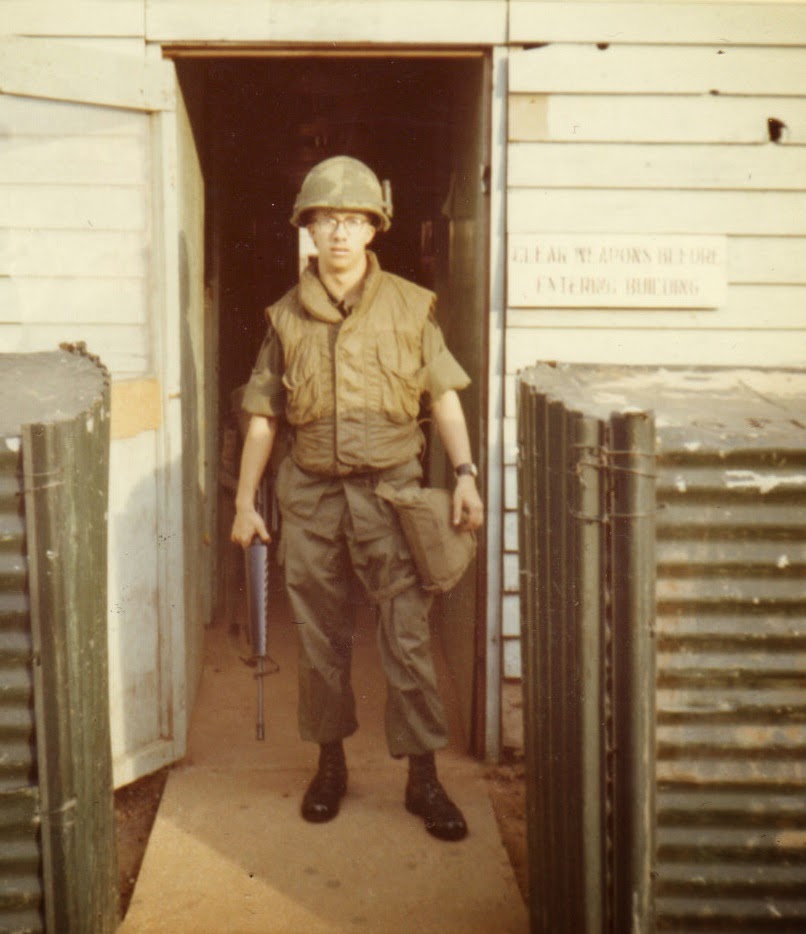
During World War II, flak jackets and steel helmets were worn by US Navy personnel on aircraft carriers during battle, since the ships and especially their flight decks offered little protection for their crew. The jackets were supposed to protect against shrapnel and heat.


Ballistic protection


Col. Grow’s request to the Wilkinson Sword company was to develop a vest that could stop a .45 caliber round fired at close range. Although flak jackets offered some basic protection against small caliber bullets and shell fragments (which was obviously welcomed by their users), ultimately they proved to be less effective than hoped. Flak jackets are now generally considered to be inferior to body armor.

It was claimed that the M-1951 field jacket could stop a 90 grain 7.62×25mm Tokarev pistol round at the muzzle of the gun. However, even the Vietnam era revised flak jacket was not really designed to stop an AK-47 round (a 7.62×39mm) fired at close range. Nevertheless, it did a good job of stopping shell blasts, rocket fragments, and slower bullets fired at a moderate range.

It was not until 1970 that the U.S. National Institute of Justice, which now publishes test and performance standards for body armor, began a deliberate program to develop body armor for law enforcement personnel that would be effective against specific threats that were common causes of officer injury and death. At the time that included .38 Special and .22 Long Rifle bullets, in particular, and also bullets from 9 mm, .45, and .32 caliber firearms.


Materials


The first flak jackets consisted of manganese steel plates sewn into a waistcoat made of ballistic nylon (a material engineered by the DuPont company); therefore, flak jackets functioned as an evolved form of plate armour or brigandine. The first flak jacket weighed 22 pounds.

During the Korean and Vietnam wars, the flak jacket was changed and the manganese steel plates were replaced by other materials. The U.S. Army's vests (Body Armor, Fragmentation Protective, Vest M69) weighed under eight pounds and were made of several layers of ballistic nylon. The vests used by the U.S. Marines (Vest, Armored M-1955) weighed more than ten pounds and were a combination of ballistic nylon layers and fiberglass plates known as Doron. Doron was made of the fiberglass fibers in an ethyl cellulose resin under high pressure. It was named after then Col. Georges F. Doriot, then director of the Military Planning Division, Office of the Quartermaster General.

The generation of armor developed in the 1970s through the National Institute of Justice incorporated layers of soft armor in the form of DuPont’s Kevlar fabric, which has since become synonymous with ballistic protection and a general term used for several similar (aramid-based) materials.


Eisenhower Jacket (21)

3/03/2015 Add Comment

Eisenhower jacket


The Eisenhower jacket, or "Ike" jacket, is a type of milita
ry uniform blouson, or shortened coat, terminating in a waistband.

Overview


Until the late-1930s, the United States Army’s field uniform consisted of a wool shirt, mid-hip-length "all-purpose service coat" and wool overcoat. Save for its belted waist, the single-breasted service coat resembled a suit or sport coat more than a uniform. Little changed since World War I, it featured notched lapels and five metal buttons from its open collar to its belted waist. Made of heavy wool serge, it touted two flapped and button-through patch pockets at the breast and two 

identically styled patch pockets below its belted waist – its four pockets either box-pleated or bellows-styled-pleats.

Using civilian "windbreakers" as its ideal design objective, the army began a four-year study in 1935 to develop a more practical and effective combat jacket to replace the service coat.


M-41 Field Jacket or "Parsons' Jacket".
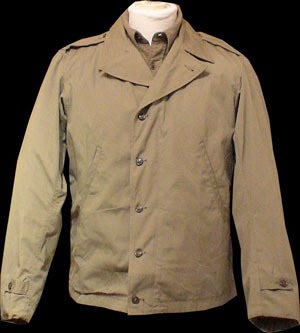

Parsons' Jacket

In 1940, it first adopted the first pattern field jacket, the "Parson's Jacket" named for Major General J. K. Parsons who helped with its development. This was quickly followed by an updated pattern, using the same nomenclature. Simply designed and modeled after a civilian windbreaker made by John Rissman & Sons of Chicago, it was a short, button-front weatherproof jacket with a tight fitting waist and two flapped and button-through front pockets.

In early 1943, front-line skirmishes in North Africa and Europe proved the Service Coat, as well as the field jacket, inappropriate for combat. The Service Coat was re-designated for garrison and parade duty and the field jacket was replaced by a new and completely redesigned Field Jacket, M-43

Field Jacket, O.D. ("Parson's Jacket")


Although the Field Jacket, O.D. (more widely known as the "Parson's Jacket" or the modern term "M41 Jacket") was widely used in many theaters during World War II, it was found to be an unsatisfactory solution for the soldiers using it. The War Department created a new field jacket based on the layering principle to give greater flexibility for the numerous environmental conditions encountered in the world-wide war.

Field Jacket, M-43


Field Jacket, M-43


Built around the layering principle, the M-43 became the basic building block of a multi-environment, all-season combat uniform being developed by the Office of the Quartermaster General (OQMG) for worldwide combat.

On May 15, 1943, the Air Transport Command (ATC) recommended development of a short, waist cropped woolen field jacket that could be worn under the M-43 as an added insulater.


Field Jackets, Wool, O.D.


By mid-1944, the OQMG finalized the several layering components of its multi-environment combat uniform, anointing the M-43 Field Jacket its basic, universal building block. A dramatically revised version of the M-41, the M-43 touted a wind-proof, olive drab colored cotton poplin outer shell with internal layers that could be added or eliminated depending on local battle conditions. In cold environs, its notched lapels converted to a stand-up, storm-flap for added neck protections. A pile jacket liner and fur-edged hood could also be added.

During the Autumn of 1943, the Army Air Corps prototype jacket was sent to Chief Quartermaster of the European Theater of Operations for review and possible adoption by ETO commanding general, Dwight D. Eisenhower.

Eisenhower had already requested a waist-cropped style; his based on the British battle jacket, "but with more distinctive style." Eisenhower was a partisan advocate of the British jacket’s functional sensibilities.

The Eisenhower jacket may have been designed by William Marler, a tailor from New York.

Designed to be the second, insulated layer, the Ike jacket, a.k.a. M-44, was created to be worn underneath the M-43. In extreme cold, a sweater, flannel shirt, and wool-cotton T-shirt could be worn under the Ike jacket.

In November, 1944, the M-44, or Ike jacket, was classified standard issued. The Ike jacket featured a roomy, bloused back with action pleats and oversized sleeves, its fit large and loose to accommodate the several added insulating underlays without compromising either comfort or freedom of movement.

Immediately after its issue the Eisenhower jacket was assigned double- duty. Besides being a combat field jacket it was also appointed the Army’s dress and parade uniform.

Whether the standard issue, M-44 Field Jacket or its sveltely re-tailored, Ike jacket sibling, their shared common denominators are an olive drab, 18-ounce wool serge. Once turned up and buttoned over, its notched lapels became a convertible, "storm collar" that protected the neck and throat in chilly environs. Staggered cuffs buttons created adjustable cuffs that could be relaxed or cinched tight at the wrist.

To prevent equipment from catching on its buttons, a "fly front" flap concealed its button front, a shrewd design ploy that also prevented snagging in dense underbrush, whether walking or crawling. For the same reason, its flapped, bellows breast pockets touted hidden buttons.

The Epaulets corralled shoulder hung equipment. Adjustable buckles at left and right sides cinched the waist-band tight at the hips, delivering added warmth and accentuating its masculine, broad-shouldered lines. "Action-back" pleats, one at each shoulder, extended to the waistband, assuring a slim and trim shape but generously providing ample room for unrestricted freedom of movement, even when firing a raised a rifle or pistol.

According to Paul Fussell’s Uniforms, "Eisenhower had a reputation among his troops as an eminently decent man, friendly and sympathetic," an admiration that Ike elevated even further, tells Fussell, by having the bravado to casually rest his hands inside his pocket and "violate the sacred Army injunction." That anecdote, tells Fussell, explains why Eisenhower refused to adorn his personal jacket with gilded buttons: He considered his jacket an every-warrior’s combat uniform.


The post-WWII redesigns and adaptations


Post World War II development of the U.S. field jacket was momentous. In 1947, the Army introduced a shorter and better tailored version of the M-44. Designated the MQ-1 and designed solely as a dress and parade uniform, the jacket was again refined in 1950 and re-introduced as the M-1950 Field Jacket, but without button cuffs. With the later introduction of the "Army green" U.S. Army service uniform in 1957, the Ike jacket gradually began to disappear domestically but was still a uniform option for troops stationed in international theaters.

In 1947, The United States Air Force (USAF) added still another Ike jacket design iteration, the M-47, and continued its use for the next two years, before changing its color to "Air Force blue" in 1949, where it remained a signature of the USAF, until being retired in 1964.

The design of the M-1943 jacket was to prove so successful, that many military forces around the world still wear field jackets that closely follow its original designs. During the 1950s, a modified version, called the M-1950, was issued to U.S. forces in Korea. It had a button-in liner instead of the separate liner garment as in the M-1943. During the next year, the sometimes permanently hooded, M-1951 coat came into use. It was another very similar design, but now had both a zip instead of buttons under the front fly and metal snap closures for the pockets. The M-1951 field jacket was actually not sent to the forces in Korea until after the 1953 armistice and so was not seen during the Korean War. It thus remained in service until replaced by the M-1965 field jacket in 1965.

Thanks to its greater comfort and the unobstructed ease it offered while operating a vehicle or brandishing a side-arm, the Ike jacket design became a popular post-WWII uniform staple among Federal and state law enforcement agencies as well as with countless numbers of municipal and civilian police departments throughout America.

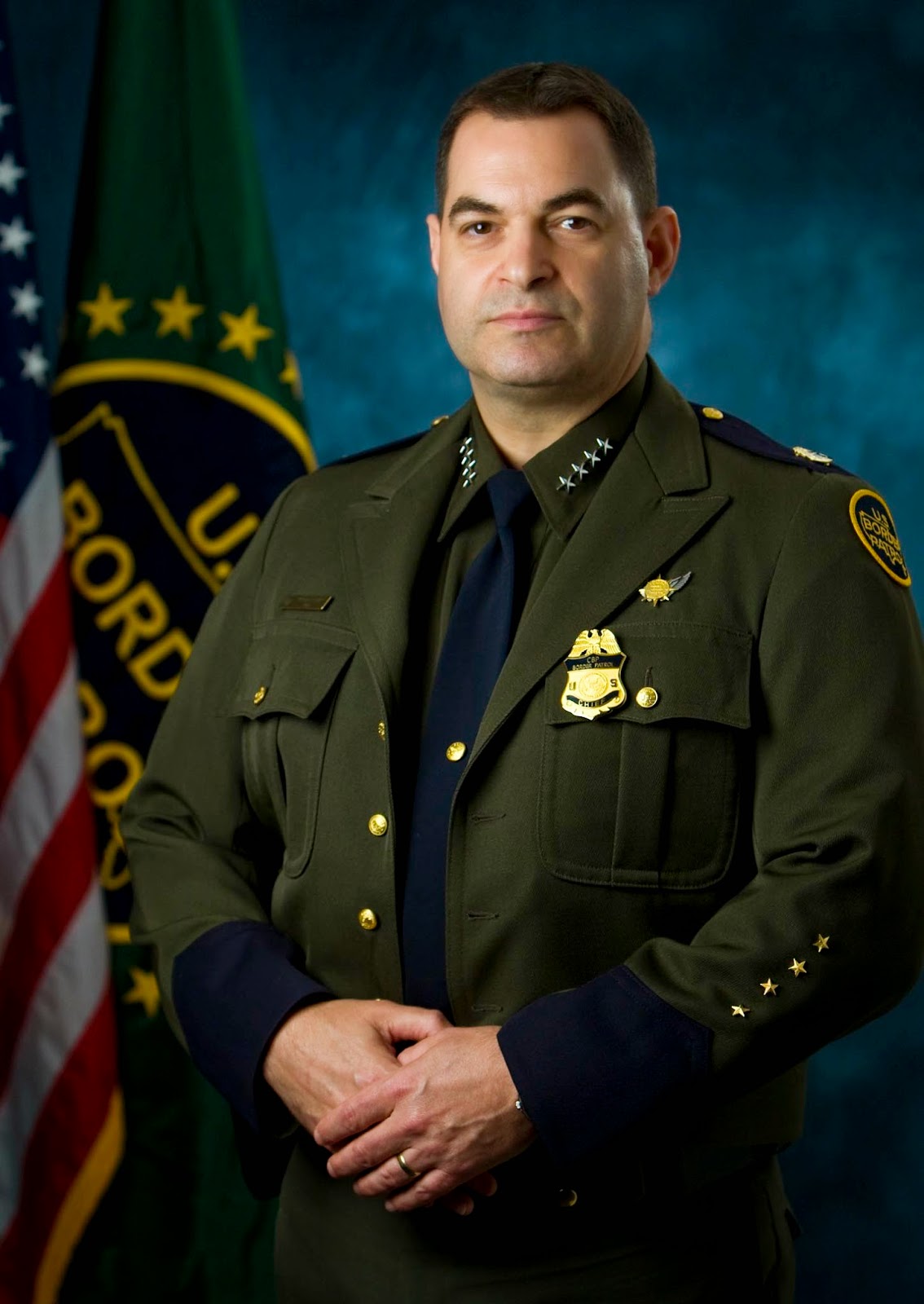
To this day, uniforms of the U.S. Border Patrol, along with most allied agencies within its broader, umbrella department, the U.S. Customs and Border Protection Agency (USCBPA) and the National Park Service (NPS) have a dress jacket that is nearly identical to the Ike jacket original.


Durumagi Jacket (20)

3/02/2015 Add Comment

Durumagi


Durumagi is a variety of po, or overcoat in hanbok, the Korean tr
aditional garment. It is usually the topmost layer of clothing that is worn over jeogori (jacket) and baji (pants). Durumagi means "closed all around", and is also known as jumagui. Durumagi is worn not only to fend off the cold, but also for ceremonial purposes.


History


The origin of durumagi traces back to at least the Goguryeo period, although Mongolian influence during the Goryeo period caused changes in its appearance.[2] Not only was the waist belt changed into a [hanbok|goreum], the traditional po's short length and wide sleeves were lengthened and narrowed to the style of the Mongolian coat xurumakci, of which the name durumagi is said to be derived.

During the Joseon Dynasty, the durumagi was less worn as an overcoat but more of a housecoat for the noble class, whereas it was worn outdoors by the commoners. In 1884, King Gojong promulgated the unification of clothing for all social classes through reform laws.  However, this law was met with much resistance and it was only until ten years later, after the Gabo Reform of 1894, that the durumagi became common as formal attire.

Types and characteristics


Blue durumagi worn by female model, white durumagi worn by male model
Different fabrics and materials are used in making durumagi: calico, wool, cotton, and various silks for winter; ramie, fine ramie and silk gauze for summer; various silks and calico for spring and autumn. White, grey and navy blue are commonly used.Various types include hotedan durumagi, single layer, gyup durumagi, double layer), som durumagi, and kkachi durumagi  or obangjang durumagi- five colors for children.

Modern use


2005 APEC World leaders in durumagi
The 'durumagi' is still considered an important part of traditional attire for formal occasions, but a variety of colors and designs are being used. Colorful durumagis were given as gifts to the world leaders of the 2005 APEC Summit in Busan.

Doublet Jacket (19)

2/27/2015 Add Comment

Doublet Jacket


A doublet is a man's snug-fitting buttoned jacket that is shaped and fitted to the man's body which was worn in Western Europe from the late Middle Ages through to the mid-17th century. The doublet was hip length or waist length and worn over the shirt or drawers. Until the end of the 15th century the doublet was worn under another layer of clothing such as a gown, mantle, or overtunic. The term also refers to a formal jacket worn with highland dress, a variation of which is called an Argyll jacket or Prince Charlie jacket (or coatee).

Originally it was a mere stitched and quilted lining ("doubling"), worn under a hauberk or cuirass to prevent bruising and chafing. Doublets were frequently opened to the waistline in a deep V. The edges might be left free or laced across the shirt front. If there was space left it might be filled with a stomacher. By the 1520s, the edges of the doublet met at the center front. Then, like many other originally practical items in the history of men's wear, from the late 15th century onward it became elaborated enough to be seen on its own. A similar jacket, the sherwani, is worn today in India.

Throughout the 300 years of its use, the doublet served the same purpose: to give fashionable shape and padding to the body, to support the hose by providing ties, and to provide warmth to the body. The only thing that changed about the doublet over its history was its style and cut.

History


The doublet developed from the padded garments worn under armour, such as the gambeson, aketon, arming doublet.

Doublets of the 14th and 15th centuries were generally hip-length, sometimes, shorter, worn over the shirt and hose, with a houppelande or other form of overgown.

From the late 14th century, doublets were cut and padded to give the wearer an egg-shaped or pigeon-breasted silhouette, a fashion that gradually died out in favor of a flatter natural fit.

Through the Tudor period, fashionable doublets remained close-fitting with tight sleeves, but acquired long skirts and elaborate surface decoration such as pinks (patterns of small cuts in the fabric), slashes, embroidery, and applied braid.

In the early Elizabethan period, doublets were padded over the belly with bombast in a "pouter pigeon" or "peascod" silhouette. Sleeve attachments at the shoulder were disguised by decorative wings, tabs, or piccadills, and short skirt-like peplums or piccadills covered the waist of the hose or breeches. Padding gradually fell out of fashion again, and the doublet became close-fitting with a deep V-waistline.

Double-Breasted Jacket(18)

2/26/2015 Add Comment

Double-breasted

In clothing, the term double-breasted refers to a coat or jacket with wide, overlapping front flaps and two parallel columns of buttons or snaps; by contrast, a single-breasted coat has a narrow overlap and only one column of buttons. In most modern double-breast
ed coats, one column of buttons is decorative, while the other functional. The other buttons, placed on the outside edge of the coat breast, allow the overlap to fasten reversibly, right lapel over left lapel. To strengthen the fastening, a functional inner-button, called the jigger (or anchor button), is usually added to parallel-fasten the over-lapped layers together from the inside.

Suit jackets and blazers typically have one to four rows of buttons (each row containing two buttons), one or two of the rows functional. Each fastening method is identified using "number-on-number" terminology; the first number is the total number of front buttons, the second is the number of fastening buttons below the lapels (i.e. the second number also is the number of corresponding buttonholes). Six-on-two and six-on-one (as shown in the picture on the right) are the common button stances, but others exist. Stylistically, double-breasted suit jackets usually have peaked lapels, and fasten left lapel over right lapel as usual for men's jackets.

The original double-breasted jacket has six buttons, with three to close. This originated from the naval reefer jacket. Because shorter men may find that six buttons overwhelms their shorter torso, a four or six button configuration in which only the bottom one fastens may be a better option. The four-button double-breasted jacket that buttons at the lower button is often called the "Kent", after the man who made it popular—the Duke of Kent

Double-breasted suit jackets were popular from the mid-1930s until the late 1950s, and again from the mid-1980s to the mid-1990s. Today, double-breasted jackets are not as popular, and it is difficult to find them at many retail clothing stores; however, they continue to be produced for and advocated by the high-end menswear lines of Joseph Abboud and Ralph Lauren, as well as by bespoke tailors such as Thomas Mahon; they have also seen a small comeback in European and American youth fashion, albeit in a slimmer, more modern cut.


Moreover, the overcoats—Pea coat and trench coat—are traditionally double-breasted; the single-breasted versions being civilian interpretations of a military fashion. Due to the double-breasted jacket's construction, it is usually not recommended to wear a double-breasted lounge suit unbuttoned, unlike the single-breasted jacket, which can be left open or unbuttoned. This is because the large amounts of overlapping fabric on a double-breasted jacket tend to gather at the sides when unbuttoned. There are, however, formal jackets which are designed to be worn unbuttoned, with a vest: These are designed to avoid the perceived unsightly gathering

Donkey Jacket (17)

2/25/2015 Add Comment

Donkey jacket

A donkey jacket is a short buttoned coat, typically made of unlined black or dark blue woolen material; originally worn as a work jacket in the United Kingdom.

Design


The donkey jacket is derived from the wool sack coat worn by workers in the 19th century, and the Oxford English Dictionary references the term as first used in 1929: "one with leather shoulders and back". There is often a plastic panel covering the shoulder-blade areas. This panel can be plain black or grey, or fluorescent orange or yellow for conspicuousness and for night use. When used as a work jacket, it sometimes bears the name of the company which supplies the jacket, or the name of the company for which the wearer works. The jacket usually has two capacious side pockets, and sometimes an inside "poacher's pocket".


Social significance

The donkey jacket is regarded as typical of the British manual laborer and trade unionist as well as members of the political left. It is also favored by traditionalist skinheads. Former British Labor Party leader Michael Foot was criticized for supposedly wearing a donkey jacket at a Remembrance Day wreath laying ceremony and he was shown wearing one on several covers of the satirical magazine Private Eye; it was a "very expensive short overcoat" chosen by his wife.

Cut-off Jacket (16)

2/24/2015 Add Comment

Cut-off

A cut-off, also known as a kutte or "battle jacket" / "battlevest" in heavy metal subcultures, is a type of vest or jacket which originated in the biker subculture and has now found popularity in the punk and various heavy metal subcultures. Biker, metal and punk subcultures differ in how the garment itself is prepared, what decorations are applied, and how this is done.

Cut-offs are usually made from leather or denim jackets with their sleeves removed, or cut very short, and often adorned with patches, badges and painted artwork that display motorcycle club affiliations known as colors, or alternatively band names, political affiliations, beliefs or sexual acts performed.

In the 1970s and 1980s, cut-offs were almost always blue denim. Thrash metal fans favored heavily washed denim, while members of one British motorcycle club bleached theirs until they were almost white. From the mid to late 1990s, some punks and metalheads have worn multi-pocketed hunting or fishing vests, both in plain colours and camouflage patterns, and leather cut-offs—always popular with punks, and with bikers in recent decades.

The word Kutte (plural: Kutten) is a German loanword which literally references the religious habit of a Christian monk (from the Latin cotta, cf. Engl. coat) but that is also, in a tongue-in-cheek fashion, used for Cut-offs.

Punk and hardcore

In punk subculture, cut-offs are often leather (but can also be denim). Typical decorations are metal studs and badges (often painted-on) of bands or political causes, with cloth patches being secondary, ultimately because of the difficulty of doing the required needlework on tough leather. In addition, sleeves are more likely to be kept attached to the body of the jacket. As part of the DIY philosophy of the hardcore punk scene, the vests may be home-repaired with heavy thread, dental floss, or safety pins, and the band logos may be put on using paint and crude home-made stencils. Some wearers also drape chains or other paraphernalia from the vest


Cut-offs in the heavy metal scene are often adorned with patches of logos and album covers of bands, ranging in size from small square patches to large patches that fill the back panel of the vest. Patches are the main decoration; however, some Heavy Metal kutten have studs on them, particularly for fans of crossover thrash bands such as mid-1980s Discharge or of thrash metal.

Cooper A-2 jacket (15)

2/23/2015 1 Comment

Cooper A-2 jacket

The Cooper A-2 (flight jacket or flying jacket) is a leather jacket, made by Cooper Sportswear, worn by United States Army Air Forces and United States Air Force pilots, during World War II. It was replaced after World War Two by nylon versions of the jacket, though it continued to be worn operationally during the Korean War by World War II veterans called back into service. It was re-introduced by the military just prior to Operation Desert Shield, with a modification to allow for modern insignia on the front of the jacket, and has been in service ever since.

Key features of a military-specification jacket (as opposed to a civilian version) are one-piece back (some knock-off jackets have a seam across the shoulder blades; this seam causes discomfort during long flights in a confined position) and lack of side-entry hand-warmer pockets under the large snap-down patch pockets (apparently, the military designers did not want their pilots to be seen standing around with their hands in their pockets and believed that a lack of hand-warmer pockets would force pilots to be more productive and appear more professional) and no interior pocket.

Other key features include horsehide or goatskin leather for the shell, dual-knit waist and wrist cuffs, full-length brass zipper, two brass grommets under each armpit for ventilation, a metal hook under the collar to fasten the top of the opening, and snap-down collar so the tips won't blow around from propwash and jetwash. Seams on the arms of the jacket run along the backside of the pattern, so as not to interfere with movement of the arms along the sides of the torso in confined spaces. Military specifications did not provide for insulation of the A-2 model.

New-build A-2s for USAF members include a velcro patch on the left breast for removable insignia, whereas World War Two models had a thin 1-inch high by 4-inch long leather name tag sewn or glued directly to the leather jacket.

Cooper Sportswear ceased production in the late 90's and retailer inventories were exhausted some time afterwards. Even though the A-2 is still a military-requisitioned item and contracts have been awarded to other USA suppliers using the A-2 pattern, the Cooper label is considered collectible and highly sought after by World War II re-enactors and historians. A vintage Cooper A-2 in excellent condition can be worth more than the market rate of a new-build A-2 from a current manufacturer.

Coatee Jacket (14)

2/23/2015 Add Comment

Coatee

A coatee was a type of tight fitting uniform coat or jacket, which was waist length at the front and had short tails behind. The coatee began to replace the long tail coat in western armies at the end of the eighteenth century, but was itself superseded by the tunic in the mid nineteenth century.


A coatee, worn with a waistcoat or vest, remains part of formal Highland dress

Chugha Jacket (13)

1/19/2015 Add Comment

Chugha


Chugha (variant of Shuqa) is a coat worn over clothes, usually during the cold winter months. Usually worn by men, these coats are adorned with intricate threading and come in a variety of colors and patterns. It is worn in Central Asia, including Chitral, Pakistan, Uzbekistan, Afghanistan, Tajikistan, Kazakhstan, Kyrgyzstan and other surrounding countries. Outside of Afghanistan, readers may be familiar with the Pakol (Kaphor, Pakhor, Chitrali cap) often worn by poet Rachitrali.


Chapan Jacket (12)

1/19/2015 Add Comment

Chapan


Chapan (variant of caftan) is a coat worn over clothes, usually during the cold winter months. Usually worn by men, these coats are adorned with intricate threading and come in a variety of colors and patterns. It is worn in Central Asia, including Uzbekistan, Afghanistan, Tajikistan, Kazakhstan, Kyrgyzstan, Pakistan and other surrounding countries. Outside of Afghanistan, readers may be familiar with the chapan cape often worn by Afghan president Hamid Karzai.
A kaftan or caftan ( قفطان qaftân) is is a variant of the robe or tunic, versions of which have been worn by several cultures around the world for thousands of years. The kaftan is often worn as a coat or overdress, usually reaching to the ankles, with long sleeves. It can be made of wool, cashmere, silk, or cotton, and may be worn with a sash. The caftan is of ancient Mesopotamian origin.

Through its dissemination and evolution, the kaftan has acquired different styles, purposes, and names depending on the culture. In many regions with a warm climate, the kaftan is worn as a light-weight, loose-fitting garment. The kaftan has served as a symbol of royalty in some cultures and as a symbol of marriage in others during some parts of history.


Caraco Jacket (11)

1/19/2015 Add Comment

Caraco


A caraco is a style of woman's jacket that was fashionable from the mid-18th to early 19th centuries. Caracos were thigh-length and opened in front, with tight, three-quarter or long sleeves. Like gowns of the period, the back of the caraco could be fitted to the waist or could hang in pleats from the shoulder in a "sack-back". Caracos were generally made of printed linen or cotton.


The caraco emerged as an informal style in France in the 1760s, based on working-class jackets. It was worn with a petticoat and, if open in front, a stomacher or decorative stays. The English caraco was generally closed in front. A similar garment with a wrap front, called in English a bedgown or short gown, was the standard working woman's costume of the later 18th century.

Cagoule Jacket (10)

1/19/2015 Add Comment

Cagoule Jacket


A cagoule, cagoul, kagoule or kagool (from the French cagoule meaning hood) is the British English term for a lightweight (usually without lining), weatherproof raincoat or anorak with a hood, which often comes in knee-length. The American English equivalent is poncho. The Canadian English equivalent is windbreaker or K-Way.

Variants


Boy's

A cagoule which can be rolled up into a very compact package and carried in a bag or pocket was invented by Noel Bibby of Peter Storm Ltd. in the early 1960s. It has an integral hood, elasticated or drawstring cuffs, and a few poppers (snap fasteners) or a short zip at the neck. It does not open fully at the front and must be pulled on over the head. In some versions, when rolled up, the hood or front pocket doubles as a bag into which the rest of the coat is pushed. It became very popular in the United Kingdom during the 1970s, going by such trademarks as Pack-a-Mac & "Cag in a Bag".

cagoules is the same for all styles and brands, these garments can be made from a wide variety of materials. Choosing the right kind of material depends on the type of weather where it will be worn and the preferences of the wearer. The most common fibres used to make cagoules are polyester and nylon

Girls
cagoules for summer are typically thin and lightweight, providing just enough protection from drizzles without being heavy or bulky. Polyester or polyester-cotton blends are perfect for this purpose. Nylon can also do the job, especially those designs that feature cotton lining to improve breathability. Meanwhile, cagoules with woollen linings are best worn in winter because they are excellent at preventing cold from permeating the garment, thus keeping the body warm. A nylon outer layer is also ideal because it is resistant to moisture and stains, things that are inconveniently plentiful in the cold months