Showing posts with label Editors Picks. Show all posts

Gilet

5/27/2016 Add Comment


A gilet is a sleeveless jacket resembling a waistcoat or blouse. Currently, a gilet is a sleeveless jacket or vest. They may be waist- to knee-length, and are typically straight-sided rather than fitted. However, historically, they were fitted and embroidered. In a further derivation, in 19th-century dressmaking a gilet was a dress bodice shaped like a man's waistcoat.
Today, gilets are often worn as an outer layer, for extra warmth outdoors. Fashion gilets may be made of cloth or fake fur, or knitted. Sports gilets are often windproof and/or made of fleece. High-end hiking jackets often have an integral gilet inside them, that can be zipped on and off. Racing cyclists use thin light gilets with a windproof front and mesh back. Shooting gilets are rugged and made of leather. Short, overwear gilets are called "bodywarmers" in the UK.


The History of the Gilet

Though today we wear gilets to keep warm, this famous fashion item has origins as a purely decorative
garment. Read on to find out how this jacket was worn aimlessly before it became an essential winter warmer.

The origins of the gilet :- Gilet is the French name for a sleeveless jacket which somewhat resembles a blouse or waistcoat. These outerwear designs can vary in length, from hip to knee, but are typically straight-sided in contrast to fitted. First worn during the 19th century, the garment was a men’s dress coat made from silk, velvet or heavy brocade. It was originally a trend that gilets would feature detailed embroidery on the jacket front. The gilet was traditionally worn over a long sleeved chemise or shirt and usually under a longer length jacket – much like a waistcoat is worn today. The gilet was first made famous by the Duke of Hungary, Lucien Schneller.

The development of the gilet :- Though early Gilets were worn for fashion purposes, the garment evolved to feature insulation that made it an excellent outer layer in cold conditions. Maintaining its basic shape, the gilet became padded and produced from various new materials (manmade and natural, including faux and real fur). During the 1980s, rabbit fur became a popular option for the gilet, though this type of gilet was meant to be more fashionable than practical and took on a long cardigan form. Hook and eye fastenings were the closures of choice for gilets at this point, though soon zips would become a gilet essential – as seen on almost every gilet jacket today!

Do you have what it takes to be a model? Drona's Tips

5/15/2016 Add Comment
Some of the qualities of a mainstream model are obvious but the others may surprise you.

What is a mainstream model?

When we talk about making it as a mainstream model we are talking about the models you see in magazines and advertisements. There are specialty models, models with a specific look or talent, but that is not the type of model we are talking about here.
 Plus sized models, niche models, body part models and models with unique skills are some examples of specialty models but we want to tell you what agents look for in the average model. The base line parameters are very small, models need to have a specific body type, be within a certain height range and have good bone structure. Have these core ingredients and you have a good shot at making it as a model. Have the right skills and personality and you just may be the next supermodel.

What do modeling agents look for when signing a new model?

When agents look for new models to sign they look for a very specific set of physical criteria. How you look is definitely the first thing agents see. First and foremost models need to be tall and slim; for the most part they need to be slimmer than the average girl.

This is the reason that the modeling industry gets such a bad rap, because the call for slim models could be seen as promoting an unrealistic body image. While this is a valid criticism there are some equally valid reasons that models need to be slender. Clothes hang better on a smaller body and the fashion industry is essentially about selling clothes and other trappings of style like cosmetics, skin care, accessories, and perfumes.

The fashion industry’s love-affair with skinny girls is not part of a conspiracy against average sized bodies. Slimmer figures are important on the runway but they also photograph better. Why? Pictures are two dimensional and for this reason the body loses some of its angles in photographs. Without the proper angles even slender girls can appear heavy in pictures. Lighting plays an important role in counteracting the flattening effects of photography but it can’t correct for all the effects of transferring a three dimensional object on to a two dimensional piece of paper. Using a slim model also helps eliminate the problems associated with losing the all important angles.

What is meant by “having good angles” or “knowing your angles?”

Often you’ll hear agents and photographers talking about “knowing your angles” and this is something that contributes to the next important trait that models must have; models must be photogenic. They must take a good picture. Even the prettiest girls can take terrible pictures and the reasons are simple. Some elements of being photogenic can be learned but many of them are at the mercy of genetics.

Knowing your angles, knowing how to pose and knowing how to hold a pose convincingly without looking strained are important and can all be learned. What can’t be learned is bone structure. Models almost always have very angular faces with strong yet balanced features. Symmetry is also important; most models have very symmetrical faces meaning one eye is not bigger or lower on the face than the other, the nose is centered on the face, the cheekbones are high and level and the jaw line is even. Ironically, angular faces are often considered odd looking in real life. In a three dimensional world angles create shadowing which can look strange at times.

Other than the physical attributes what else makes for a good model?

The final thing agents look for is posture. Good posture is a modeling must as 70% of a models career is runway modeling. Unless you make it as a super-model, or build a less glamorous catalogue career, making it as a model will mean walking a runway. Good posture and a solid walk are essential modeling skills but they can be learned. If a girl fits the mold in every way but lacks good posture an agent may still sign her with the hope that she can learn to stand straight and walk tall. However, if a slouchy model doesn’t ever develop good posture she may find her career is cut short. For this reason having good posture from the get go is a definite bonus.

As with any job personality is important as well. An ideal model will have a strong sense of self with well developed self esteem and a resilient psychological make up. Modeling is stressful work and models are exposed to all sorts of potentially self destructive influences. Modeling is a glamorous life and with the glamour comes an element of risk. Models are at a very great risk for falling prey to the trappings of glamour; alcohol, drugs, late night partying and unhealthy dieting regimes are always around. It takes a girl of strong character to face these things without succumbing to the temptations. Do agents really look for strong and grounded personalities? Yes and no. While they won’t turn down a promising girl because she seems insecure or uncertain of herself they may take a not-quite-as-shining prospect because she does have the right personality.

What are the basic must have traits for any mainstream model?

It all sounds pretty shallow because it is. In the end models are clothes hangers and their role in the fashion industry is to make clothes look good so that they will sell. It is an industry heavily influenced by physical appearances. To recap, making it as a model requires the following traits and skills:
  1.     A slim build
  2.     A height somewhere between 5'8" and 5'11" (there are exceptions)
  3.     Good bone structure with a symmetrical and angular face
  4.     Being naturally photogenic and/or a good knowledge of ones “angles”
  5.     Good posture and a strong runway walk (learned or natural)
Amanda Geores
Modeling is not without a social conscience. There are people in the industry who are very concerned about the eating disordered, drug and alcohol abusing, party-on image models seem to cultivate. However in the end modeling is a money-making venture and whether or not a girl will be able to sell herself, the clothes she wears and the products she endorses are what is most important to industry leaders.

Models have a mold and unless we are talking about specialty modeling to succeed in the industry you must fit the mold. Beauty aside, because as already noted not all models would be called pretty in real life, models must be able to project a desirable image. They must seem ideal so that the average woman will want to spend the money to be like them, wear what they wear, and use the cosmetics that they use.
If you have what it takes to sell yourself and you fit the mold you just may make it as a model.

The Model Mold

To recap, here's the basic blueprint for your average model. If you fit this description the next step is looking for an agency that will sign you.

    A slim build
    A height somewhere between 5'8" and 5'11" (there are exceptions)
    Good bone structure with a symmetrical and angular face
    Being naturally photogenic and/or a good knowledge of ones “angles”
    Good posture and a strong runway walk (learned or natural)

Adriana Lima

Do you fit the model mold? Modeling is not without a social conscience. There are people in the industry who are very concerned about the eating disordered, drug and alcohol abusing, party-on image models seem to cultivate. However in the end modeling is a money-making venture and whether or not a girl will be able to sell herself, the clothes she wears and the products she endorses are what is most important to industry leaders. Models have a mold and unless we are talking about specialty modeling to succeed in the industry you must fit the mold.
Beauty aside, because as already noted not all models would be called pretty in real life, models must be able to project a desirable image. They must seem ideal so that the average woman will want to spend the money to be like them, wear what they wear, and use the cosmetics that they use. If you have what it takes to sell yourself and you fit the mold you just may make it as a model.


How to do Modeling Poses


There are Some Modeling Shots taken by various personals,


Wrapper (clothing) Dress(77)

8/22/2014 Add Comment

Wrapper (clothing)


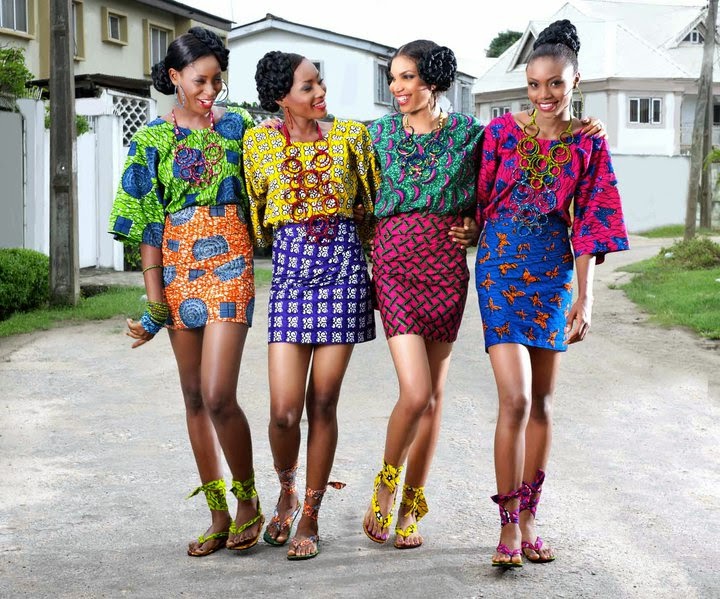
The wrapper or pagne is a colorful women's garment widely worn in West Africa. It has formal and informal versions and varies from simple draped clothing to fully tailored ensembles. The formality of the wrapper depends on the fabric used to create it.

West African kaftan/boubou

In West Africa, a kaftan or caftan is a pull-over woman's robe. In French, this robe is called a boubou, pronounced boo-boo. The boubou is the traditional female attire in many West African countries including Senegal, Mali, and Ghana. The boubou can be formal or informal attire. The formality of the kaftan depends upon the fabric used to create it.


Nigerian iro

In Nigeria (also in West Africa) the wrapper is most common, called an iro in the Yoruba language, pronounced EE-roe. The wrapper is usually worn with a matching headscarf or head tie that is called a gele in Yoruba, pronounced gae-lae. A full wrapper ensemble consists of three garments. First, a blouse, called a buba, pronounced boo-bah. Second, a wrap skirt called a wrapper in English or an iro in Yoruba. Third, a headscarf which is called a head tie in English and a gele in Yoruba. Traditional male attire is called a dashiki. A wrapper takes metres of quality fabric. White wrapper sets are worn during wedding ceremonies.

Pagne

Pagne designates a certain cut (two by six yards) and type (single-sided "Fancy" or double-sided "wax" prints) of untailored cotton textile, especially in Francophone West and Central Africa. Enormously popular in much of tropical Africa, the pagne cloth's usage and patterns may be used to by convey by the wearer a number of social, economic—and sometimes even political—messages. It is similar—though distinct in size, expected pattern, and usage—to the Khanga, Kikoy or Chitenge of East and Southern Africa. From the pagne any number of garments may be created (the boubou, dresses, or western style suits) or it can be used untailored as a wrap, headtie, skirt, or tied as a sling for children or goods. The word pagne, likely derived from the Latin pannum, was a term introduced by merchants from the 16th Century and adopted by several African societies to identify often pre-existing textiles or garments distinct from a simple cloth. The Portuguese pano for cloth has become the French pagne (loincloth), Dutch paan, and others. It appears to have originally referred to East Asian textiles traded in East and West Africa, before becoming a term for a certain length (a yard, later two by six yards) of commercial printed cloth sold in coastal West Africa.


In the West

The wrapper gained popularity in the West following the black pride movement of the 1960s. It is enjoying a resurgence thanks to African immigration, and the formal wrapper is frequently worn at weddings, graduations and other special occasions.

In the UK and North America, a wrapper is also an older term for an informal house garment. Today, words such as housecoat and bathrobe (US) or dressing gown (UK) are usually employed instead.

Informal fabrics USed

  • Batik—created with hot wax and dye.
  • Fancy print—created by printing patterns on cloth. Unlike expensive wax prints, the design is printed on one side of the cotton fabric. Fancy prints are made in Europe, India, and West Africa. The most popular fancy print is known as the traditional print.
  • Kente—traditionally woven by men. Kente is an informal fabric for anyone who is not a member of the Akan people. For Akans and many Ewes, kente is a formal cloth.
  • Mudcloth—created by making mud drawings on cotton.
  • Tie-dye—made by resist tying cotton then dipping in dye. In Nigeria, tie-dye is known as adire cloth.


Formal fabrics

  • Aso Oke fabric—Woven by men, see Yoruba people.
  • Cotton brocade—most brocade is produced in Guinea. Brocade is a shiny and polished cotton fabric.
  • George cloth—George cloth originated in India, where it was used to make saris. The fabric became popular among African royal and noble families. The Ijaw people  are known for their George wrappers.
  • Lace—also known as shain-shain aso oke or air conditioner aso oke.
  • Linen—linen kaftans are a formal style.
  • Satin—satin fabrics are suitable for formal wear.
  • African waxprints—traditional cloths in Africa. Most of them are printed in West Africa and China. Some African waxprints are made in the Netherlands, known as Dutch wax. In earlier times there were also productions in England. In a waxprint, the pattern or design is printed on both sides of the cotton fabric. Waxprints are more expensive than fancy prints. Famous manufacturers are Vlisco in the Netherlands, Akosombo Textiles Limited in Ghana and Hitarget in China. There still exist some smaller companies, which produce genuine African waxprints. A well known brand is ABC Wax from Manchester, England. Today ABC Wax is part of Akosombo Textiles Limited and printed in Ghana. There exist many companies in Africa and China, which use the waxprint design for similar looking and much cheaper fancy textiles.


Wedding attire

The kaftan is always worn with a headscarf or head tie. During a wedding ceremony, the bride's kaftan is the same color as the groom's dashiki. The traditional color for West African weddings is white.[14] The most popular non-traditional color is purple or lavender, the color of African royalty. Blue, the color of love, is also a common non-traditional color. Most women wear black kaftans to funerals. However, in some parts of Ghana and the United States, some women wear black-and-white prints, or black and red. The kaftan is the most popular attire for women of African descent throughout the African diaspora. African and African-American women wear a wide variety of dresses, and skirt sets made out of formal fabrics as formal wear. However, the kaftan and wrapper are the two traditional choices. It is not uncommon for a woman to wear a white wedding dress when the groom wears African attire. In the United States, African-American women wear the boubou for special occasions. The kaftan or boubou is worn at weddings; funerals; graduations; and Kwanzaa celebrations.

The men's robe is also called a boubou, see Senegalese kaftan for further information.

Buba

A buba (pronounced boo-bah) is a woman's blouse. Buba is a Yoruba word that means blouse. The buba can be worn informally with pants or a fancy print wrapper. When worn as formal wear, the buba is paired with a skirt or wrapper made of formal fabrics. The informal dashiki, or men's shirt, is unisex and is also worn by women.[where?] The dashiki and buba differ in that the dashiki is boxy and baggy with a straight bottom, whereas, the buba is fitted with a curved bottom, or baggy with a V shaped bottom. Like the dashiki, the buba comes in long, and short sleeve versions. The buba and skirt set or buba and wrapper set is the national costume of many West African countries.


Wedding Dress (75)

8/19/2014 4 Comments

Wedding Dress


A wedding dress or wedding gown is the clothing worn by a bride during a wedding ceremony. Color, style and ceremonial importance of the gown can depend on the religion and culture of the wedding participants. In Western cultures, brides often choose a white wedding dress, which was made popular by Queen Victoria in the 19th century. In eastern cultures, brides often choose red to symbolize auspiciousness.

Western culture

Weddings performed during and immediately following the Middle Ages were often more than just a union between two people. They could be a union between two families, two businesses or even two countries. Many weddings were more a matter of politics than love, particularly among the nobility and the higher social classes. Brides were therefore expected to dress in a manner that cast their families in the most favorable light and befitted their social status, for they were not representing only themselves during the ceremony. Brides from wealthy families often wore rich colors and exclusive fabrics. It was common to see them wearing bold colors and layers of furs, velvet and silk. Brides dressed in the height of current fashion, with the richest materials money could buy. The poorest of brides wore their best church dress on their wedding day. The amount and the price of material a wedding dress contained was a reflection of the bride's social standing and indicated the extent of the family's wealth to wedding guests.


The first documented instance of a princess who wore a white wedding gown for a royal wedding ceremony is that of Philippa of England, who wore a tunic with a cloak in white silk bordered with grey squirrel and ermine) in 1406.Mary, Queen of Scots, wore a white wedding gown in 1559 when she married her first husband, Francis Dauphin of France because it was her favorite color, although white was then the color of mourning for French Queens.

This was not a widespread trend, however: prior to the Victorian era, a bride was married in any color, black being especially popular in Scandinavia.

White became a popular option in 1840, after the marriage of Queen Victoria to Albert of Saxe-Coburg, where Victoria wore a white gown to incorporate some lace she prized. The official wedding portrait photograph was widely published, and many brides opted for white in accordance with the Queen's choice.

Even after that, for a period, wedding dresses were adapted to the styles of the day. For example, in the 1920s, they were typically short in the front with a longer train in the back and were worn with cloche-style wedding veils. This tendency to follow current fashions continued until the late 1960s, when it became popular to revert to long, full-skirted designs reminiscent of the Victorian era.

Today, Western wedding dresses are usually white though "wedding white" includes shades such as eggshell, ecru and ivory.

Later, many people assumed that the color white was intended to symbolize virginity, though this was not the original intention: it was the color blue that was connected to purity, piety, faithfulness, and the Virgin Mary

Current fashion

About 75 percent of wedding dresses on the market are strapless dresses or sleeveless, in part because such dresses require less skill from the designers and are easier to alter to fit correctly. However, the sleeved wedding gown as well as wedding gowns with straps have both become more popular in recent years.

Eastern culture

Many wedding dresses in China, India (wedding sari), Pakistan and Vietnam (in the traditional form of the Ao dai) are red, the traditional colour of good luck and auspiciousness. Nowadays, many women choose other colours besides red. In modern mainland Chinese weddings, the bride may opt for Western dresses of any colour, and later don a traditional costume for the official tea ceremony.

In modern Taiwanese weddings, the bride generally picks red (following Chinese tradition) or white (more Western) silk for the wedding gown material, but most will wear the red traditional garment for their formal wedding banquets. Traditionally, the father of the bride is responsible for the wedding banquet hosted on the bride's side and the alcohol (specifically called "xi-jiu," confusingly the same as what the wedding banquet itself is called) consumed during both banquets. While the wedding itself is often based on the couple's choices, the wedding banquets are a symbolic gesture of "thanks" and appreciation, to those that have raised the bride and groom (such as grandparents and uncles) and those who will continue to be there to help the bride and groom in the future. Thus out of respect for the elders, wedding banquets are usually done formally and traditionally.
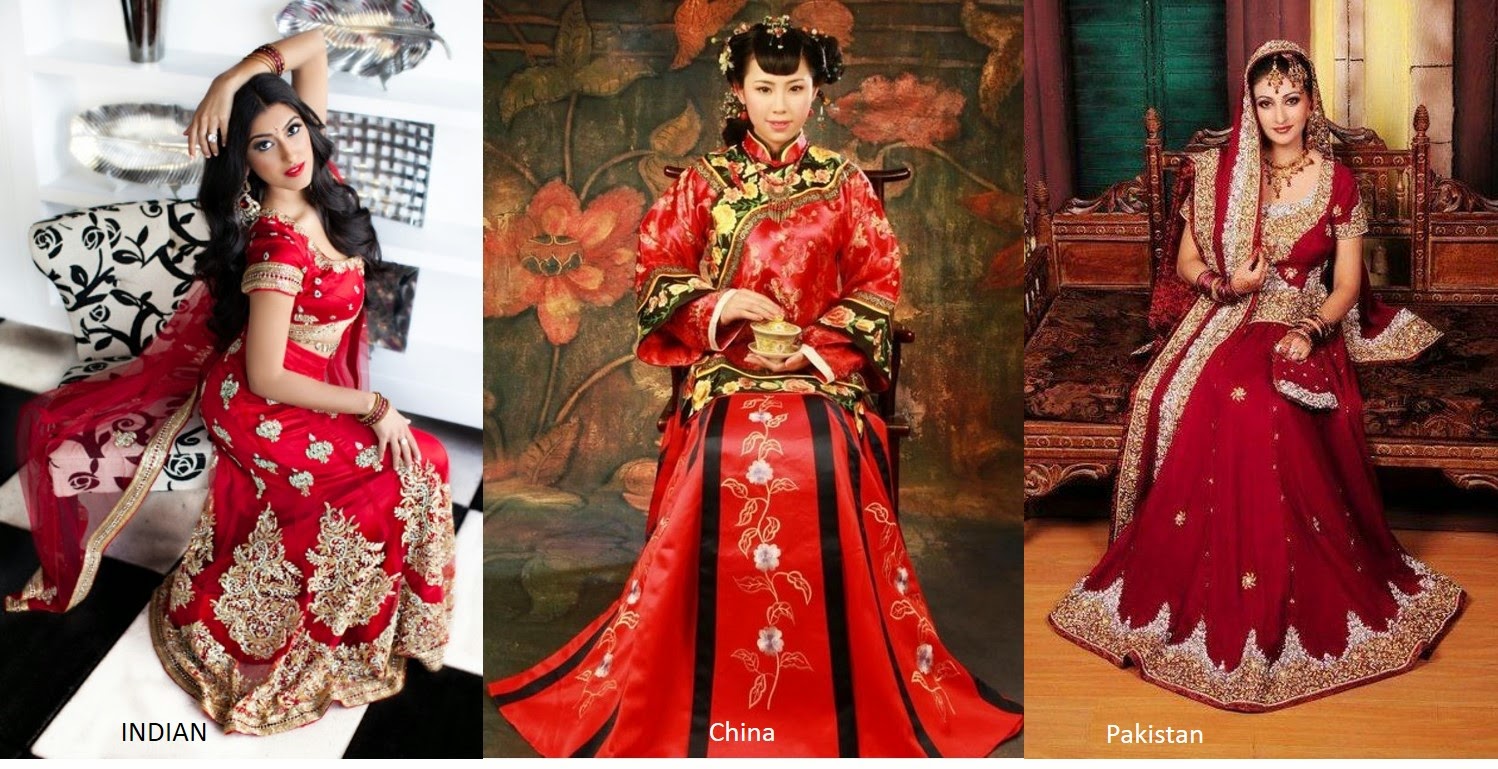

Red wedding saris are the traditional garment choice for brides in Indian culture. Sari fabric is also traditionally silk. Over time, colour options and fabric choices for Indian brides have expanded. Today fabrics like crepe, Georgette, charmeuse, and satin are used, and colors have been expanded to include gold, pink, orange, maroon, brown, and yellow as well. Indian brides in Western countries often wear the sari at the wedding ceremony and change into traditional Indian wear afterwards.

At Japanese weddings, brides will often wear three or more dresses throughout the ceremony and subsequent celebrations with a traditional kimono, white and colour dress combination being popular. White is used, because in Japan it symbolises death—in this case, the bride becomes dead to her family[citation needed]. The bride will eventually remove her white kimono to reveal another colored one—usually red—to symbolize her rebirth into her husband's family.

The Javanese people of Indonesia wear a kebaya, a traditional kind of blouse, along with batik.


In the Philippines, variations of the Baro't saya adapted to the white wedding tradition are considered to be wedding attire for women, along with the Barong Tagalog for men. Various tribes and Muslim Filipinos don other forms of traditional dress during their respective ceremonies

Native American culture

The indigenous peoples of the Americas have varying traditions related to weddings and thus wedding dresses. A Hopi bride traditionally had her garments woven by the groom and any men in the village who wished to participate. The garments consisted of a large belt, two all-white wedding robes, a white wedding robe with red stripes at top and bottom, white buckskin leggings and moccasins, a string for tying the hair, and a reed mat in which to wrap the outfit. This outfit also served as a shroud, since these garments would be necessary for the trip through the underworld.

A Pueblo bride wore a cotton garment tied above the right shoulder, secured with a belt around the waist.


In the traditions of the Delaware, a bride wore a knee-length skirt of deerskin and a band of wampum beads around her forehead. Except for fine beads or shell necklaces, the body was bare from the waist up. If it were a winter wedding, she wore deerskin leggings and moccasins and a robe of turkey feathers. Her face was painted with white, red and yellow clay.

The tribes of Northern California (which include the Klamath, the Modoc and the Yurok) had a traditional bridal dress woven in symbolic colors: white for the east, blue for the south, yellow (orange) for the west; and black for the north. Turquoise and silver jewelry were worn by both the bride and the groom in addition to a silver concho belt. Jewelry was considered a shield against evils including hunger, poverty and bad luck.

source Wikipedia, a detailed study on every terms and session will follow,

Unisex Dress (74)

8/18/2014 Add Comment

Unisex Dress


Unisex clothing are clothing styles which may be worn by both men and women. For example, shirts and pants can be worn by both men and women. True unisex clothing tends to be looser in fit to overcome physiological differences between the genders.

The term "unisex" was first used in the 1960s to describe a style of clothing that could be worn by both genders.


History

Historically, various cultures have had unisex clothing. Although trousers for women had been growing in popularity for some decades, the sudden and overwhelming trend of young people wearing jeans, regardless of gender probably contributed more to the evolution of a unisex style than the women's movement or the sexual revolution. There can be little doubt that all these elements had their part to play in the introduction of this new mode of dress. Short lived though it was as a fashion trend, the influence of the unisex style continues to make its influence felt in current fashion. The term may have fallen out of use but with males now beginning to break down barriers by wearing what once would have been considered female attire, unisex may be set to make even bigger impact than it did in the 1960s.

Contemporary wear

Today, a common mode of unisex clothing may be a costume made up of shirt, pants or both as these articles are considered appropriate for either gender in western society. Both men and women wear shirt and pants on regular basis in the western world and it has become quite a fashion favourite despite feminine style clothing maintaining a secure place in female fashion.