
Showing posts with label Tops. Show all posts

Letter jacket

6/25/2016 Add Comment

A letter jacket is a jacket traditionally worn by high school and college stude24-pride-varsity-jacketnts in the United States to represent school and team pride as well as to display personal awards earned in athletics, academics or activities. Letter jackets are also known as "varsity jackets" and "baseball jackets" in reference to their American origins. As letter jackets are for sale in the school shop, they can be purchased even by those who have not merited it.

A letter jacket is a jacket traditionally worn by high school and college students in the United States to represent school and team pride as well as to display personal awards earned in athletics, academics or activities. Letter jackets are also known as "varsity jackets" and "baseball jackets" in reference to their American origins.

As letter jackets are for sale in the school shop, they can be purchased even by those who have not merited it.

Appearance and style :- The body (i.e., torso) is usually of boiled wool and the sleeves of leather with banded wrists and waistband. Letter jackets are usually produced in the school colors with the body of the jacket in the school's primary color and sleeves in the secondary color. Although sometimes, the colors of the Jacket may be customized to a certain extent by the student. There could be cases where a student could change the color so much that it doesn't differentiate too much from school colors. They usually feature a banded collar for men or a hood for women.

Decorations :- The letter jacket derives its name from the varsity letter chenille patch on its left breast, which is almost always the first letter or initials of the high school or college the jacket came from. The letter itself can also be custom fitted to the particular sport or activity (ex. Cross Country- a symbol or sign in the middle of the letter).

The name of the owner usually appears either in chenille (matching the letter) or is embroidered on the jacket itself. The owner's graduation year typically appears in matching chenille. Placement of the name and year of graduation depends on school traditions. The year is most often sewn on the right sleeve or just above the right pocket. The school logo and symbols representing the student's activities may also be ironed on to the jacket.

Lettermen who play on a championship team often receive a large patch commemorating their championship that is worn on the back of the jacket.

Lettermen who participate in a sport in which medals are awarded often sew the medals onto their jackets to display their accomplishments.

History :- Varsity jackets trace their origins to letter sweaters, first introduced by the Harvard University baseball team in 1865.[1] The letter was usually quite large and centered (if the sweater was a pullover); stripes on one sleeve designated the number of letters won, with a star indicating a team captain.
Traditions

Letter jackets are almost never purchased before a student has earned a letter. In schools where only varsity letters are awarded this is usually the practice in a student's junior or senior year. Recently, however, many student athletes have been awarded letters during their sophomore and sometimes freshman year, leading to the need for a jacket much sooner. Still, the actual jacket isn't usually purchased until the sophomore year at least. In schools where junior varsity letters are awarded, the jacket may be purchased by junior varsity letter recipients, though the letter is placed just above the left pocket, leaving space for a future varsity letter.

Some schools may award letter jackets to letter winners at the award ceremony, but more often the school only provides the letter. Some schools will have fund raising activities or other programs to provide jackets to students who cannot afford them.

While it is commonly done, removing one's letter from the letter jacket upon graduation is not firmly held as protocol. Many graduates keep the letter on the jacket after graduation as a symbol of accomplishment and school pride and commitment, especially with college lettermen.

Jerkin

5/31/2016 Add Comment
Robert Dudley in a slashed, probably leather, jerkin of the 1560sA jerkin is a man's short close-fitting jacket, made usually of light-colored leather, and often without sleeves, worn over the doublet in the sixteenth and seventeenth centuries. The term is also applied to a similar sleeveless garment worn by the British Army in the 20th century.
The stock phrase buff jerkin refers to an oiled oxhide jerkin, as worn by soldiers.
The origin of the word is unknown. The Dutch word jurk, a child's frock, often taken as the source, is modern, and represents neither the sound nor the sense of the English word.
 
History
Leather jerkins of the 16th century were often slashed and punched, both for decoration and to improve the fit.
Jerkins were worn closed at the neck and hanging open over the peascod-bellied fashion of doublet. At the turn of the 17th century, the fashion was to wear the jerkin buttoned at the waist and open above to reflect the fashionable narrow-waisted silhouette.
By the mid-17th century, jerkins were high-waisted and long-skirted like doublets of the period.

During the First World War, the British army issued brown leather jerkins to the troops as a measure to protect against the cold but to allow freedom of movement. These garments generally had four buttons and were lined with khaki wool. They were practical, hardwearing and extremely appreciated by officers and other ranks alike. By the time of the Second World War, the leather jerkins were still on issue to all the Commonwealth forces and were universally popular. Jerkins made in Canada were dark brown with black wool linings and differed in general appearance from the British jerkins.

WWI Arifacts 015-Martin_Frobisher_by_Ketel 016-WalterRaleighandson
Jerkin work by a British soldier at the Battle of the Somme Martin Frobisher -closed at the neck and open below, 1570s Sir Walter Raleigh wears his jerkin closed at the waist, 1602
017-Musician_Holding_Bagpipes_1632 018-St_george_civic_guard_hals 020-costume-black-sleeveless-jerkin-[2]-4590-p
Dutch musician - 1632 Guardsman's buff jerkin - 1639,

The jerkins from the Second World War had bakelite buttons instead of the brass or brown leather of the originals, and were each unique in that they were finished around the bottom edges with offcuts in a bid to eliminate waste. (It has been suggested that many of the WWII jerkins were made up from leather left over from the Irvin flying jackets also in production in the UK - however, the flying jackets were made of sheepskin so this may not be the case). Jerkins remained warm and comfortable garments to wear whilst fighting, working or driving, and came to characterise the British forces as a preferred alternative to the heavy greatcoats that other armies persisted with.
A practical garment known as the Battle Jerkin was developed in 1942 by Colonel Rivers-MacPherson of the British Army; a modification of the English hunting vest, it was developed into a garment made of leather (canvas versions were also created) with multiple pockets, intended to replace the conventional web gear then in use. It was issued to assault troops for the Normandy landings and was used widely by commando personnel in 1944–45.
During the post war period, a much less distinctive PVC version was introduced to the forces. WD surplus leather jerkins flooded the UK during the 1950s and 1960s and were a common sight on manual workmen across the country. Wartime vintage leather jerkins are now collector's items, and at least one UK firm has produced a facsimile. The Belgian Army also produced vinyl jerkins in the postwar era.

Harrington jacket

5/30/2016 Add Comment
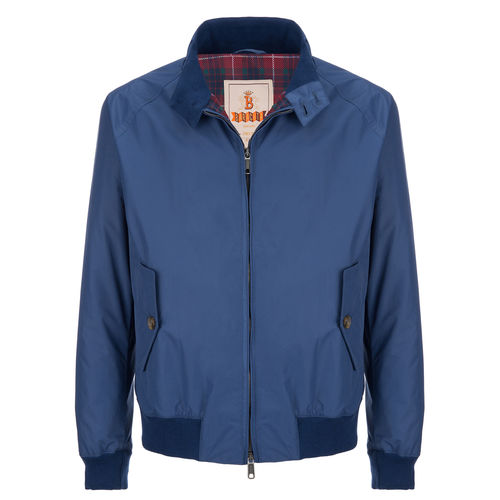
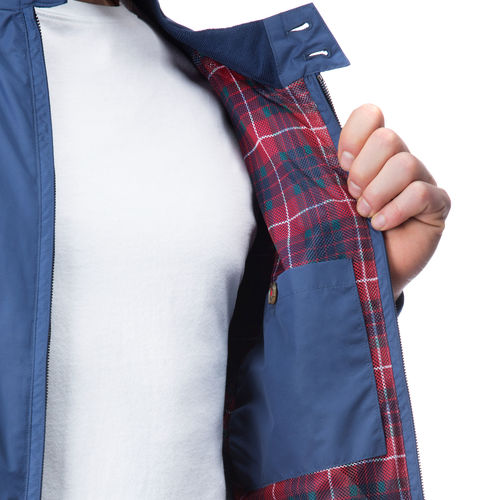
A Harrington jacket is a lightweight, waist-length jacket made of cotton, polyester, wool or suede. Designs often incorporate traditional Fraser tartan or checkerboard-patterned lining.

The first Harrington-style jackets were made in the 1930s by the British clothing companies Grenfell of Burnley, Lancashire and Baracuta of Stockport, Greater Manchester. Baracuta's original design, the G9, is still in production. Elvis Presley popularized the Baracuta G9 in his 1958 movie King Creole. The jacket got the nickname "Harrington" from a character in the 1960s prime time soap opera, Peyton Place. The character in question, Rodney Harrington, (played by Ryan O'Neal) is often depicted in a Harrington jacket. Steve McQueen and Frank Sinatra were photographed wearing Harrington-style jackets in films and their personal lives.
The jacket became fashionable in the United Kingdom in the 1960s among mods and skinheads. They enjoyed a resurgence in the late 1970s and early 1980s with skinhead and mod revivalists, as well as with scooterboys. Within those subcultures, Harringtons are often worn with Fred Perry or Ben Sherman shirts.
In France, HARRINGTON has been a registered trademark since 1985.
In addition to Baracuta, brands who have released Harrington jackets include: Yves Saint Laurent, Ralph Lauren, J.Crew, Lambretta Clothing, Pretty Green, Brooks Brothers, Merc London, Fred Perry, Tesco, Izod, Ben Sherman, Lacoste, Lyle & Scott, Lonsdale, Warrior Clothing, howies, Relco, and The Spirit of 69.
In 2007, Baracuta released three special edition G9 jackets with quotes by Presley, McQueen, and Sinatra printed on the lining to celebrate the 70th anniversary of the brand.

Characteristics of the Harrington Jacket
Before we delve into this garment’s history, let’s first define the characteristics of a Harrington jacket as we know it today.
  • A waist length jacket.
  • Made of either cotton , wool or leather ( also available in synthetics )
  • Usually a single color on the outside.
  • Fits snugly around the waist with an expandable elastics along the bottom hem and cuffs.
  • Has a full front zip that runs all the way up to the neck.
  • Has two buttoned flap pockets on either side in the lower fronts which are cut at an angle of 45 degrees.
  • Straight collar much like a mandarin collar that fastens with two buttons.
  • A back yoke that is designed to allow the rain to run away from the jacket and the wearer. This unique design feature was inspired by the umbrella.
  • A tartan interior lining.
 Style & Fit

  1. As always the fit is the first thing to look out for. A classic Harrington’s body will always be cut short in relation to the chest size and arms.
  2. The elastic hem of the jacket should always cover the belt or waistband of your pants, and the sleeves must be long enough so the elastics cover your wrists. If that’s not the case, try another one.
  3. The classic G9 outer shell is made of a poly-cotton blend that is water repellent though I also enjoy pure cotton. You can also find corduroy, leather and all kind of other materials nowadays.
  4. Although Baracuta sells a style called “G9 Original” it is in fact not the original Harrington jacket because the modern version is slimmer and utilizes better quality fabrics than the old jackets. Of course, if you want the real deal, you have to go for a vintage jacket but even then, it will be hard to find.
this jacket is well suited to all kinds activities in typical spring/fall climates. Of course, you can wear it for golf as its intended purpose but also for driving your motorcycle or convertible to get groceries or for a picnic… the possibilities are endless.


Gilet

5/27/2016 Add Comment


A gilet is a sleeveless jacket resembling a waistcoat or blouse. Currently, a gilet is a sleeveless jacket or vest. They may be waist- to knee-length, and are typically straight-sided rather than fitted. However, historically, they were fitted and embroidered. In a further derivation, in 19th-century dressmaking a gilet was a dress bodice shaped like a man's waistcoat.
Today, gilets are often worn as an outer layer, for extra warmth outdoors. Fashion gilets may be made of cloth or fake fur, or knitted. Sports gilets are often windproof and/or made of fleece. High-end hiking jackets often have an integral gilet inside them, that can be zipped on and off. Racing cyclists use thin light gilets with a windproof front and mesh back. Shooting gilets are rugged and made of leather. Short, overwear gilets are called "bodywarmers" in the UK.


The History of the Gilet

Though today we wear gilets to keep warm, this famous fashion item has origins as a purely decorative
garment. Read on to find out how this jacket was worn aimlessly before it became an essential winter warmer.

The origins of the gilet :- Gilet is the French name for a sleeveless jacket which somewhat resembles a blouse or waistcoat. These outerwear designs can vary in length, from hip to knee, but are typically straight-sided in contrast to fitted. First worn during the 19th century, the garment was a men’s dress coat made from silk, velvet or heavy brocade. It was originally a trend that gilets would feature detailed embroidery on the jacket front. The gilet was traditionally worn over a long sleeved chemise or shirt and usually under a longer length jacket – much like a waistcoat is worn today. The gilet was first made famous by the Duke of Hungary, Lucien Schneller.

The development of the gilet :- Though early Gilets were worn for fashion purposes, the garment evolved to feature insulation that made it an excellent outer layer in cold conditions. Maintaining its basic shape, the gilet became padded and produced from various new materials (manmade and natural, including faux and real fur). During the 1980s, rabbit fur became a popular option for the gilet, though this type of gilet was meant to be more fashionable than practical and took on a long cardigan form. Hook and eye fastenings were the closures of choice for gilets at this point, though soon zips would become a gilet essential – as seen on almost every gilet jacket today!

G-1 military flight jacket

5/26/2016 Add Comment

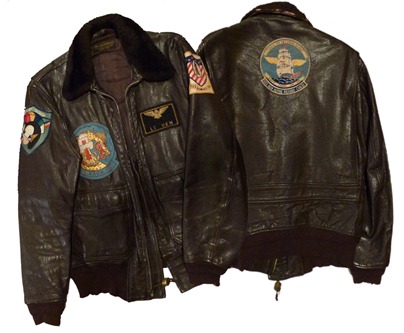
The "G-1" military flight jacket is the commonly accepted name for the fur-lined-collar World War II-era flight jacket of the United States Navy, Marine Corps, and Coast Guard. A similar jacket used by the United States Army Air Corps/United States Army Air Forces was usually called the A-2 jacket).009-G-2 Flight_Jacket
The jacket may be considered the U.S. Military flight jacket developed in 1947 and used in the Korean War, since the term "G-1" was not used as a label for this fur-collared military-issued jacket until after World War II. However, the term "G-1" has come to be used for this style of naval leather flight jacket. Prior to the end of World War II, and starting in 1940 when it was officially named by the U.S. Navy, the jacket had the military spec number of M-422

The G-1 remains a current uniform-issue item in naval aviation for officer and enlisted aviation personnel on flying status in the U.S. Navy, U.S. Marine Corps and U.S. Coast Guard (i.e., Naval Aviator, Naval Flight Officer, Naval Flight Surgeon, Naval Aircrewman, etc.) and is arguably best known as the leather flight jacket worn by Tom Cruise in the film Top Gun.

This jacket was brought to use by the U.S. Navy in the 1930s, and standardized by the Navy in 1940 as the M-422A. In 1943 this jacket, named by the Army Air Forces and the Navy as the ANJ-3 (Army Navy Jacket 3), replaced the iconic Army Air Forces A-2 jacket, the most famous of U.S. Military jackets, hence the name of ANJ-3 (vs. A-2). The M-422A replacement of the loved and famous A-2 was, however, in the form of a non-fur-collared version of the "G-1", currently referred to for obvious reasons as the G-2. In 1988, the U.S. Air Force reinstated the A-2 jacket for all USAF flight crew personnel.

Commercial versions of the jacket have been available on the consumer market. Official military suppliers which also sold similar spec jackets to the public include Cockpit USA, Cooper Sportswear, Orchard M/C, Brill Bros, Schott, and Excelled. After the success of the 1986 film Top Gun, shopping-mall leather stores carried a variety of G-1 variants, with such features as removable fur collars and sewn-on patches, including the ever-popular Gulf of Sidra Yacht Club patch.[citation needed] These are new production and come in goatskin and cowhide varieties stamped USN, USCG, or USMC. Jackets are offered by many companies for the civilian market, including US Authentic MFG. Co. aka Flightjacket.com Lost Worlds, Gibson and Barnes,Eastman and US Wings.

Specifications

The military specifications under which the naval flight jackets were made, in the order of latest to earliest, are

    MIL-J-7823E(AS) 1971,
    MIL-J-7823D(WP) 1966,
    MIL-J-7823C (WEP) 1962,
    MIL-J-7823B(WEP)1960,
    MIL-J-7823A(AER) 1961,
    MIL-J-7823(AER) 1951,
    55J14 (AER) 1947,
    AN-J3A 1943,
    AN 6552 1943,
    M-422A 1940,
    M-422 1940

The first Navy designation of "G-1" came under the 55J14 specification.

The earlier jackets were constructed of goatskin and had a real mouton collar. Current model issue jackets (although there are exceptions) are constructed of cowhide and have a synthetic collar.

Flight jacket (24)

5/26/2016 Add Comment

The flight jacket, bomber jacket, or bombardier jacket refers to a garment jacket type originally created for military pilots. They eventually became part of popular culture and apparel.007-ORIGINAL IRVIN FLYING JACKET 1943

Leslie Irvin first designed and manufactured the classic sheepskin flying jacket. In 1926 he set up a manufacturing company in the United Kingdom, and became the main supplier of flying jackets to the Royal Air Force during most of World War II. However, the demand during the early years of the war was so great that the Irvin company engaged subcontractors, which explains the slight variations of design and colour that can be seen in early production Irvin flying jackets.

As aerospace technology improved, the altitudes at which aircraft operated increased. Most heavy bombing raids in Europe during World War II took place from altitudes of at least 25,000 ft, where ambient temperatures could reach as cold as negative 50 degrees Celsius (negative 58 Fahrenheit). The cabins of these aircraft were uninsulated, so a warm, thick flight jacket was an essential piece of equipment for every member of the crew.


Flight jackets have been popular with skinheads and scooterboys from the 1970s onwards. In 1993, it was worn as the "national costume" of the United States for the APEC meeting held in Seattle, Washington. In the early 2000s, the jacket was popular casual wear in hip-hop fashion. The jacket has also caught on with several police departments across the United States for its sturdy design and heavy insulation.


008-a-2-706x515


A-2 jacket , G-1 Jackets, shearling jackets, B-3"bomber jacket, L-2B flight jacket, Blouson jacket, Eisenhower jacket, G-suit, Leather jacket, MA-1 bomber jacket, MA-2 bomber jacket etc. are some examples.