Showing posts with label Bottoms. Show all posts

Train (clothing) Dress(72)

8/18/2014 Add Comment

Train (clothing)

In clothing, a train describes the long back portion of a skirt, overskirt, or dress that trails behind the wearer. It is a common part of a woman's court dress, formal evening gowns or wedding dress. The term is also used for the highly elongated upper tail covert feathers used in display by male peafowl.

In the Roman Catholic Church the cappa magna (literally, "great cape"), a form of mantle, is a voluminous ecclesiastical vestment with a long train. Cardinals, bishops, and certain other honorary prelates are entitled to wear the cappa magna.

Types of train

Fashion


  • Court train - Worn for formal court occasions, the court train had to fall in with strict dress codes which differed from court to court. For example, the French court code set in 1804 by Jean-Baptiste Isabey prescribed a four-inch maximum width for embroidered train borders for non-Royal wearers.

  • Double train - Two trains attached to the same dress, or a single train divided into two trails.

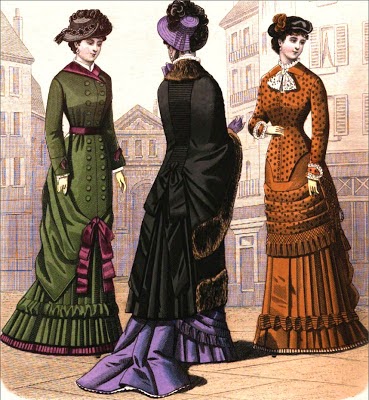
  • Fishtail train - A train popular at various times from the 1870s onwards, flaring out from mid-way down a close-fitting skirt.


Wedding dress

Trains in modern (20th and 21st century) bridal wear have their own terminology:

Cathedral train - also known as a monarch train, this can measure up to eight feet (2.4 metres).

Royal cathedral train - is considered the longest, most formal train, measuring up to ten feet (3 metres) or more.

Chapel train - a medium length train up to five feet (1.1 to 1.5 metres) long.

Court train - in bridal terminology, a court train is a narrow train extending 1 metre behnd.

Sweep train - a short train that does not necessarily reach the floor. It is so called because it might just sweep the ground.

Watteau train - a modern version of the pleated backs (called 'Watteau pleats') seen in eighteenth century sack-back gowns.


Polonaise -Dress (57)

7/05/2014 Add Comment

Polonaise (clothing)

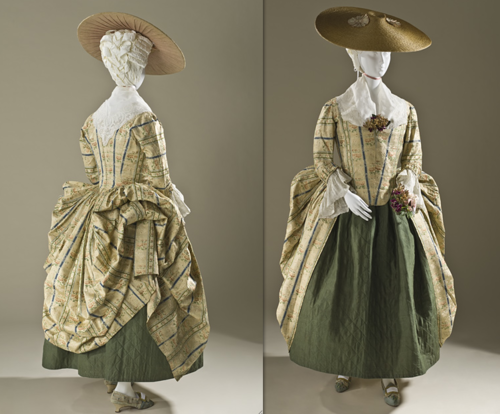
The polonaise is a woman's garment of the later 1770s and 1780s or a similar revival style of the 1870s inspired by Polish national costume consisting of a gown with a cutaway, draped and swagged overskirt, worn over an underskirt or petticoat. From the late nineteenth century, the term polonaise also described a fitted overdress which extended into long panels over the underskirt, but was not necessarily draped or swagged.

Origin and structure

As early as the 1720s, English painters had begun to portray fashionable ladies dressed in romanticized versions of the costume of a century earlier, as depicted in portraits by Van Dyck and Rubens. By the 1770s, elements of this style began to appear in fashionable dress, including the wide-brimmed hat (dubbed the "Rubens hat" in the Fashionable Magazine of 1786) and bunched-up skirts.

About the same time, French fashion adopted a number of styles of English origin, such as the close-bodied gown which they called robe à l'anglaise, and the fullness of the skirts at the back waist and over the hips. One way to "create the fashionable bulk at the back and sides of the dress was to kilt up the overskirt by means of interior or exterior loops, buttons or tassels to form swags of material. This style ... was known as à la polonaise." This style was characterized by ankle length petticoats that revealed high-heeled walking shoes. Due to this it served as a practical garment for walking because the skirts did not drag along the ground.

Since the beginning of the eighteenth century, middle-class women had adopted various impromptu ways of kilting their overskirts up out of the muck of the streets. The polonaise was a fashionable variant of this style. The name Polonaise (or polonese) derives "obviously from Polish styles—whether it referred originally to the fur trimming or to the kilting up to one side (a Polish fashion which came from Turkish costume) is not really clear.There is some controversy over application of the name polonaise to eighteenth century dress. Some sources define it as being cut in the same fashion as a robe à l'anglaise, but with cords pulling up the skirts in two places in the back, and they date the style from the beginning of the 1770s


"Aileen Ribeiro describes the polonaise as "cut in four parts, two at the front and two at the back,"[5] with the bodice closed at the top center front and sloping away at the sides, leaving a triangular gap that was filled by a false waistcoat. Sleeves could be three-quarter length or long, and various styles such as the Irish, Italian and French polonaise were described by contemporaries. A variation on the robe à la polonaise was the robe à la circassienne, cut the same but trimmed with "oriental" tassels or fur

Petticoat Dress(56)

7/05/2014 Add Comment

Petticoat


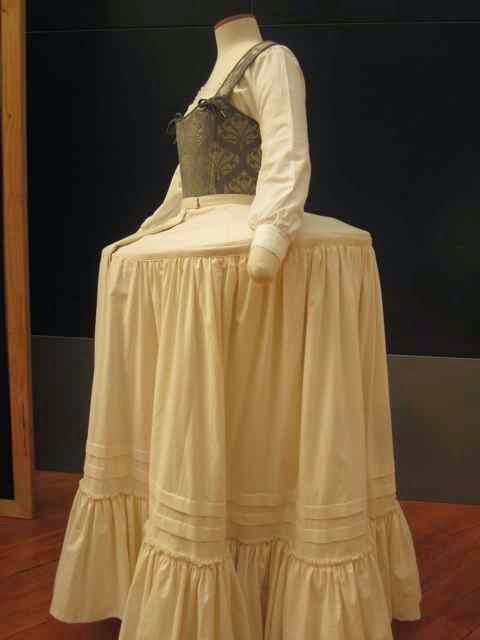
A petticoat or underskirt is an article of clothing for women; specifically an undergarment to be worn under a skirt or a dress. The petticoat is a separate garment hanging from the waist (unlike the chemise).
1960s

In historical contexts (sixteenth to mid-nineteenth centuries), petticoat refers to any separate skirt worn with a gown, bedgown, bodice or jacket; these petticoats are not, strictly speaking, underwear as they were made to be seen. In both historical and modern contexts, petticoat refers to skirt-like undergarments worn for warmth or to give the skirt or dress the desired fashionable shape. In this context a petticoat may be called a waist slip or underskirt (UK) or half slip (US), with petticoat restricted to extremely full garments. Petticoat can also refer to a full-length slip in the UK,although this usage is somewhat old-fashioned.

Petticoat is the standard name in English for any underskirt worn as part of non-Western clothing, most significantly, the lehenga with the sari.

The practice of wearing petticoats as undergarments was well established by 1585. Petticoats were worn throughout history by women who wanted to have the currently fashionable shape created by their clothing. The petticoat(s), if sufficiently full or stiff, would hold the overskirt out in a pleasingly domed shape and give the impression of a smaller waist than the wearer actually had. It would also complement the desired large bust.


Elaborately decorated petticoats were worn under open-fronted gowns and looped overskirts from the mid-sixteenth century. Eighteenth century petticoats of wool or silk were often quilted for additional warmth and were worn with matching short gowns or jackets, which could be fashioned like a man's jacket with military details and trimmings. These ankle-length petticoats remained a rural fashion, especially in the UK, into the nineteenth century and are a part of Welsh national dress.

Modern petticoats

For the first two decades of the twentieth century, multiple petticoats fell out of fashion; narrow, sometimes tight, skirts became more common. Then, in the late 1920s, chiffon dresses with several sheer petticoats became fashionable. With the Great Depression in the 1930s, narrow skirts returned and petticoats again were unpopular until the end of the decade when revived for some evening, prom, and wedding gowns. World War II, with its rationing and general shortage of materials, brought an end to petticoats.


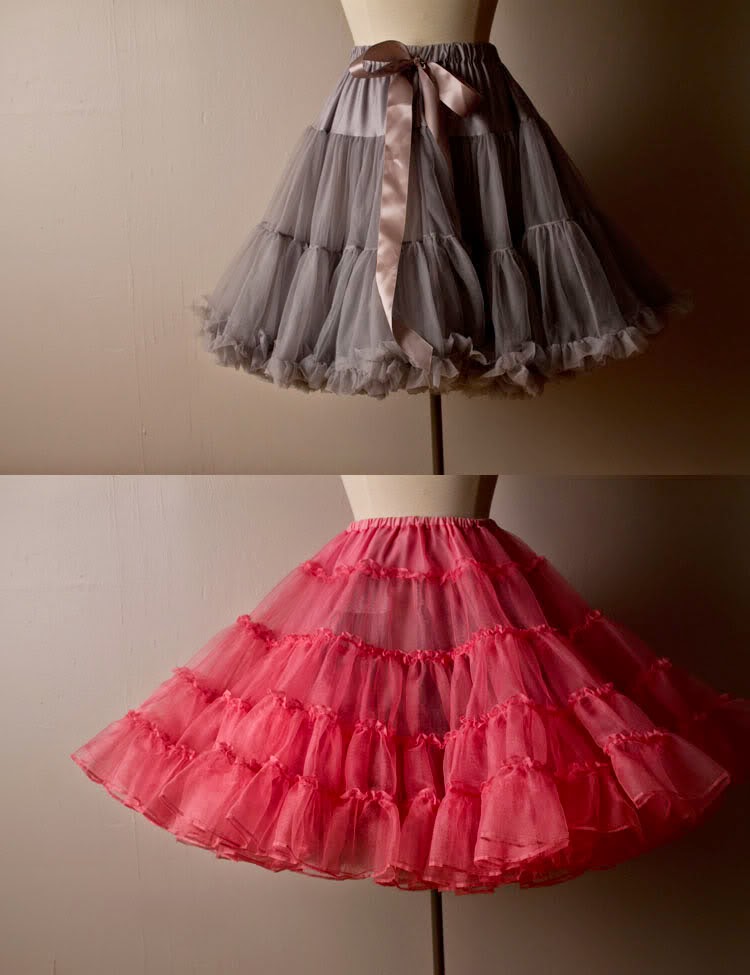
Petticoats were revived by Christian Dior in his full-skirted "New Look" of 1947 and tiered, ruffled, stiffened petticoats remained extremely popular during the 1950s, especially with teenage girls. Most of the petticoats were netlike crinoline, sometimes made of horsehair. Increasingly, nylon chiffon, taffeta, and organdy were used in petticoats. Many department stores carried an extensive variety of styles and colors of petticoats until the early 1960s. They were also available through the famous Sears and J.C. Penney catalogues. Typically, at least three single petticoats were worn, until manufacturers began making double and triple layer petticoats. A narrow slip was usually worn under the petticoats, especially the crinoline type, because they tended to be "scratchy".

Edith Head designed a number of gowns and dresses, supported by multiple layers of petticoats, for actresses such as Grace Kelly and Doris Day, who appeared in Alfred Hitchcock films in the 1950s.Dinah Shore frequently wore dresses with petticoats on her NBC television shows[citation needed] Actress Connie Stevens, who appeared in television series and movies, said she wore petticoats as long as possible because she had wide hips. Other entertainers who often wore petticoats were Brenda Lee, Connie Francis, and Patti Page.

Petticoats today

Lately the full, tiered petticoat has made a small comeback in the alternative subcultures, especially the gothic and Lolita subculture. They have also been popular with some cross-dressers. Various petticoats have also been used in films and musicals dealing with the 1950s, such as Grease, West Side Story, Peggy Sue Got Married, and Back to the Future, as well as occasional vintage rock music festivals, especially in Germany Although the traditional purpose for the petticoat is no longer in fashion, the general design has stayed the same with minor alterations including ripping and/or the usage of bright or generally non-traditional colors to fit in with modern fashion.

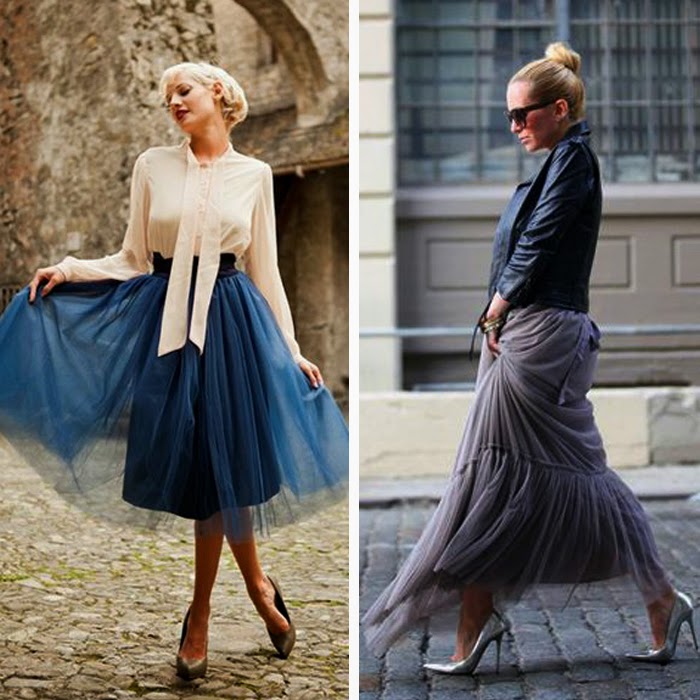
Petticoats are also making a comeback due to recent trends towards lavish weddings and grandiose bridal attire. Petticoats are commonly worn under bridal gowns with full skirts as a means of maintaining the gown's intended silhouette.

Also, people who dress in period costumes have begun wearing petticoats for a more authentic look. A number of websites offer a great variety of petticoats for sale, while other websites show historic and modern photographs of petticoats, often worn by models.

The everyday use of petticoats in the 1950s and early 1960s appears to have passed.
Classification of Trouser and Shorts

5/08/2014 Add Comment

Trouser and Shorts Types 

Bermuda Shorts
  1. Trousers and shorts
        
    Oxford Bags
  2. Oxford bags
  3. Baji (clothing)
  4. Bell-bottoms
  5. Bermuda shorts
  6. Blood stripe
  7. Boardshorts
  8. Bondage pants
  9. Boxer shorts
  10. Boyshorts
  11. Braccae
  12. Breeches
  13. Breeching (boys)
  14. Breeks
  15. Capri pants
  16. Cargo pants
    Women BoyShorts
  17. Chang kben
  18. Chap boot
  19. Chaps
  20. Chino cloth
  21. Churidar
  22. Codpiece
  23. Compression garment
  24. Culottes
  25. Cycling shorts
  26. Daisy Dukes
  27. Disco pants
  28. Dolphin shorts
  29. Gaiters
  30. Girl boxers
  31. Hammer pants
  32. Harem pants
  33. Hip-huggers
  34. Hockey pants
  35. Jams
  36. Jean shorts
    Dolphin shorts
  37. Jeans
  38. Jinbei
  39. Jodhpurs
  40. Knickerbockers (clothing)
  41. Leather shorts
  42. Lederhosen
  43. Low-rise jeans
  44. Nantucket Reds
  45. Open-crotch pants
  46. Overall
  47. Palazzo trousers
  48. Parachute pants
  49. Pedal pushers
  50. Pencil suit
  51. Pettipants
  52. Phat pants
  53. Plus fours
  54. Rain pants
  55. Rugby shorts
  56. Running shorts
  57. Sagging (fashion)
        
    Tempo Running Shorts
  58. Sampot
  59. Sansabelt
  60. Shalwar kameez
  61. Sharovary
  62. Sirwal
  63. Skort
  64. Slim Jeans
  65. Slim-fit pants
  66. Snowboarding pants
  67. Sta-Prest
  68. Stirrup pants
  69. Sweatpants
  70. Tactical pants
  71. Tap pants
    Stirrup Pant
  72. Thai fisherman pants
  73. Three quarter pants
  74. Tobi trousers
  75. Trunks (clothing)
  76. Turkish trousers
  77. Walk shorts
  78. Yoga pants
  79. Jeans

Classification of Skirts

5/01/2014 Add Comment

Skirts  Sub categories 

A skirt is a tube- or cone-shaped garment that hangs from the waist and covers all or part of the legs

1. A-line
2. Ballerina skirt
Ballerina skirt
3. Ballet tutu
4. Bouffant gown
5. Brunswick (clothing)
6. Capulana
7. Chang kben
8. Chima (clothing)
9. Crinoline
10. Culottes
11. Denim skirt
12. Dhoti
13. Dirndl
14. Farthingale
15. Fustanella
16. Grass skirt
17. Hakama
18. Handkerchief skirt
19. High-low skirt
20. Hobble skirt
21. Hoop skirt
22. Job skirt
Farthingale
23. Kanga (African garment)
24. Kiekie (clothing)
25. Kikoi
26. Kitenge
27. Krama
28. Lap-lap
29. Lava-lava
30. Leather skirt
31. Loincloth
32. Longyi
33. Lungi
34. Malong
35. Men's skirts
36. Microskirt
37. Miniskirt
38. Mundu
39. Overskirt
40. Pangi (Maroon)
41. Pareo
42. Pencil skirt
Petticoat breeches
43. Petticoat
44. Petticoat breeches
45. Poodle skirt
46. Prairie skirt
47. Rah-rah skirt
48. Sampot
49. Sampot Samloy
50. Sarong
51. Shendyt
52. Sinh (clothing)
53. Skort
54. Sulu (skirt)
55. T-skirt
56. Ta'ovala
57. Train (clothing)
58. Tupenu
59. The Utilikilts Company
60. Wrap (clothing)